
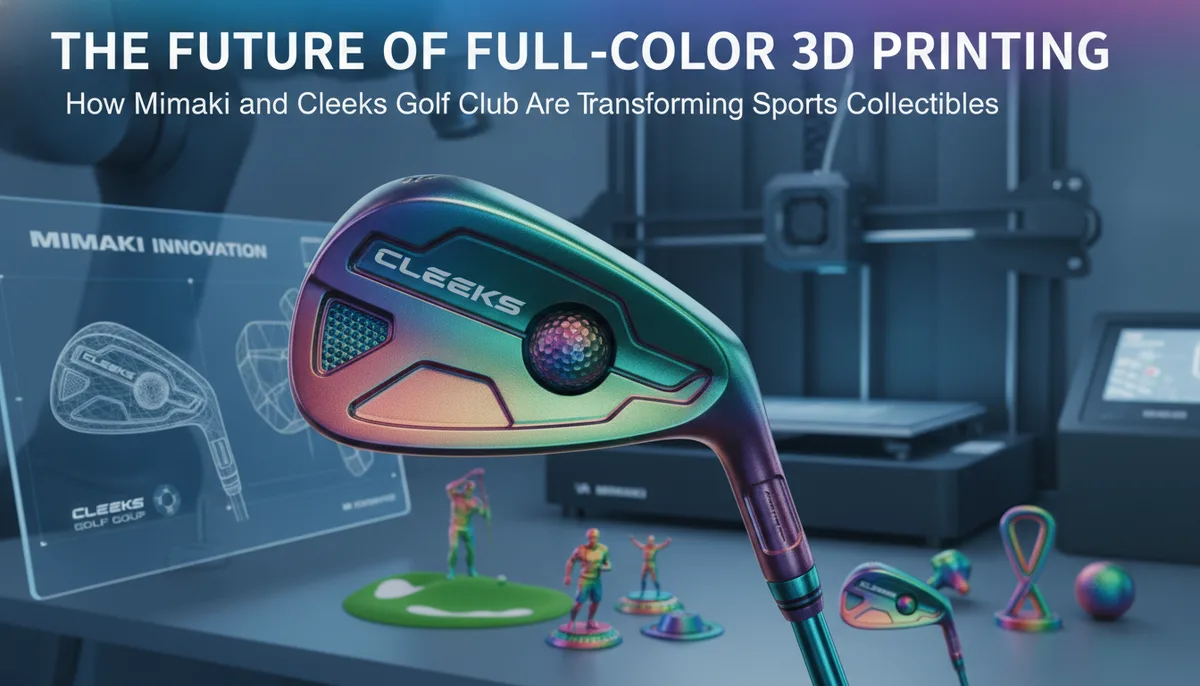
The Future of Full-Color 3D Printing: How Mimaki and Cleeks Golf Club Are Transforming Sports Collectibles
The intersection of professional sports and high-end technology has always been a breeding ground for innovation, but the latest collaboration between Mimaki Engineering and Cleeks Golf Club is taking this synergy into the palm of your hand. By producing hyper-realistic, miniature 3D-printed golf bag collectibles, these two entities are demonstrating that additive manufacturing (AM) has moved far beyond rapid prototyping and into the realm of high-fidelity consumer goods.
For fans of the LIV Golf team, these miniatures represent more than just a trinket; they are a testament to the precision of modern manufacturing. For the 3D printing industry, the project serves as a high-profile case study in the capabilities of full-color inkjet technology—a field Mimaki has pioneered for nearly three decades.
The Legacy of Mimaki: From 2D Inkjet to 3D Realism
To understand the significance of this collaboration, one must look at the technical pedigree of Mimaki Engineering. Headquartered in Japan, Mimaki has been a cornerstone of the digital printing world since the mid-90s. The company launched its first full-color inkjet printer in 1996, a move that set the stage for their eventual dominance in the wide-format printing and cutting markets.
When Mimaki established its US-based operating entity, Mimaki USA, it brought that same focus on color accuracy and industrial reliability to North American shores. While many 3D printing enthusiasts are familiar with the monochromatic layers of standard FDM machines, Mimaki’s entry into the 3D space utilized their existing inkjet expertise.
Unlike traditional printers that might require a user to choose between for basic structural parts, Mimaki’s 3D technology (specifically the 3DUJ series) uses UV-curable inkjet droplets to build objects in over 10 million colors. This allows for gradients, textures, and fine details—like the stitching on a leather golf bag or the metallic sheen of a club head—to be printed directly into the model without the need for secondary painting.
Cleeks Golf Club: Bringing LIV Golf to the Maker Space
Cleeks Golf Club, one of the prominent teams in the LIV Golf League, has consistently looked for ways to engage their fan base through unique branding. In the world of professional golf, the bag is the ultimate canvas for sponsorship and team identity. Replicating a Cleeks bag in miniature form poses a significant challenge: the logos are intricate, the color palettes are specific, and the textures are varied.
By partnering with Mimaki, Cleeks is able to bypass the limitations of traditional injection molding. Standard mass-production methods for collectibles often result in "soft" details or misaligned paint applications. 3D printing allows for:
- Perfect Logo Fidelity: Every sponsor logo and team emblem is rendered with digital precision.
- On-Demand Customization: The ability to produce limited runs for specific tournaments or player milestones.
- Complex Geometries: Capturing the internal pockets and structural nuances of a professional-grade golf bag that would be impossible to de-mold in a traditional factory setting.
The Technical Edge: How Full-Color Inkjet 3D Printing Works
While most hobbyists start with entry-level machines—often found in guides like The Best 3D Printers for Beginners This Year: Start Your Making Journey Today—industrial full-color printing operates on an entirely different level of complexity.
Mimaki’s process involves jetting tiny droplets of liquid photopolymer that are immediately cured by UV light. By mixing CMYK (Cyan, Magenta, Yellow, and Black) inks with white and clear resins, the printer can create specific shades with incredible accuracy. This is particularly vital for sports branding, where "Cleeks Green" or "Cleeks Gold" must look identical across every medium, from the player's actual jersey to a 3-inch tall miniature.
Furthermore, the use of water-soluble support material ensures that the delicate parts of the golf bag—such as the straps or the stand legs—remain intact during the printing process and are cleaned easily afterward, leaving a smooth, professional finish.
Why Sports Memorabilia is Moving Toward Additive Manufacturing
The collaboration between Mimaki and Cleeks is a harbinger of a larger trend in the $400 billion sports memorabilia market. For decades, fans have settled for mass-produced "bobbleheads" and generic plastic figurines. However, the modern collector demands authenticity and "story-telling" in their items.
1. Digital Twins for Fans
We are entering an era where a professional athlete's equipment can be 3D scanned and turned into a "digital twin." Mimaki’s technology allows these digital twins to be physically realized with 1:1 color accuracy. If a golfer uses a custom bag for the Masters, a limited edition 3D-printed replica can be available to fans within days, not months.
2. Reducing Waste in the Supply Chain
Traditional manufacturing requires massive minimum order quantities (MOQs). If a team changes sponsors or a player leaves the roster, thousands of pieces of merchandise become obsolete. 3D printing allows for "just-in-time" manufacturing, reducing the environmental impact and financial risk for teams like the Cleeks.
3. Enhanced Detail and Materiality
By utilizing clear resins, Mimaki can even simulate different materials. A miniature golf bag can feature "windows" or high-gloss sections that mimic the look of plastic or polished metal, providing a tactile experience that far exceeds standard molded plastic.
Bridging the Gap: From Industrial Tech to the Home Workshop
While the Mimaki 3DUJ series is an industrial-grade solution, the excitement surrounding these collectibles often inspires hobbyists to push the limits of their own equipment. While you may not be able to print 10 million colors on a standard home setup, there are ways to achieve high-quality results.
For those looking to get into the hobby, understanding material properties is the first step. For example, knowing PLA vs PETG: Which Filament Should You Start With? can help you decide which base to use if you plan on hand-painting your own sports miniatures. While PLA offers better detail for display pieces, PETG provides the durability needed if the collectible might be handled frequently.
If you are just starting out, investing in a reliable machine is key. You can find excellent entry-level options in our roundup of The Best 3D Printers for Beginners This Year, which covers printers that offer the precision needed for small-scale modeling.
The Road Ahead for Mimaki and the Golf Industry
The partnership with Cleeks Golf Club is likely just the beginning for Mimaki in the sports sector. As the technology becomes more accessible, we can expect to see:
- Personalized Fan Gear: Imagine a 3D-printed miniature of your own golf bag, complete with your name and local club logo, printed using the same Mimaki tech used for the pros.
- Interactive Trophies: Tournament trophies that incorporate 3D-printed elements of the specific course or the winning player's gear.
- Historical Replicas: Using 3D scanning and Mimaki’s color printing to recreate vintage golf equipment from the early 20th century for museum displays and high-end collectors.
Mimaki’s journey from a 1996 inkjet pioneer to a 2024 leader in 3D-printed sports collectibles is a testament to the power of specialized engineering. By focusing on color—the most human element of design—they have bridged the gap between the digital file and the physical world in a way that few other companies can match.
Final Thoughts: A New Standard for Quality
The Cleeks Golf Club miniatures are more than just toys; they are high-fidelity representations of a brand’s identity. As Mimaki Engineering continues to refine its digital printing and cutting products, the line between "manufactured" and "crafted" will continue to blur. For the 3D printing community, this collaboration serves as an inspiration to look beyond the layer lines and focus on the potential of full-color, photorealistic creation.
Whether you are a professional looking to utilize industrial AM or a hobbyist looking for 5 Essential Upgrades for Your First 3D Printer, the lesson from Mimaki is clear: precision, color, and detail are the keys to creating something truly memorable.