
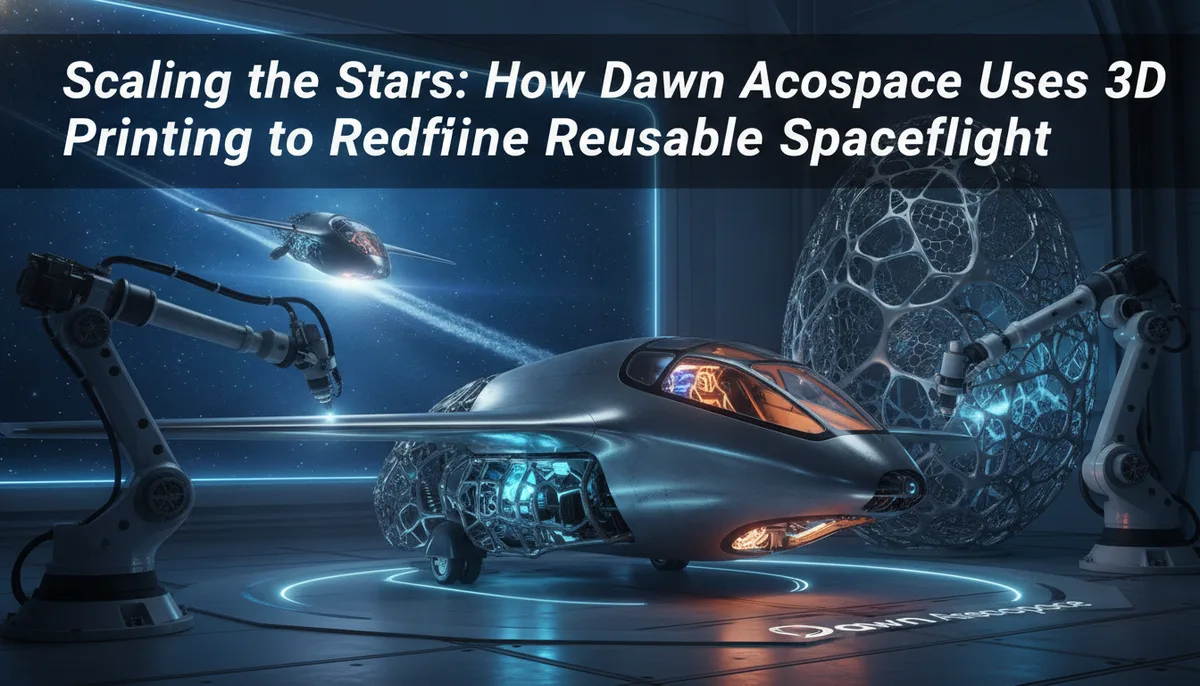
Scaling the Stars: How Dawn Aerospace Uses 3D Printing to Redefine Reusable Spaceflight
The dream of frequent, affordable access to space has long been hindered by the prohibitive costs of "single-use" rocketry. For decades, reaching orbit meant building a multi-million dollar machine, only to watch it burn up in the atmosphere or sink to the bottom of the ocean after a single mission. However, the tide is turning. Dawn Aerospace, a leader in the next generation of space transportation, recently announced a massive $25 million Series B funding round.
This investment isn't just a win for the company; it is a testament to the maturing role of additive manufacturing—better known as 3D printing—in the aerospace sector. By leveraging 3D printing to create highly efficient, reusable propulsion systems, Dawn Aerospace is positioning itself to bridge the gap between traditional aviation and orbital logistics.
The Strategic Role of 3D Printing in Modern Rocketry
At the heart of Dawn Aerospace's success is a commitment to advanced manufacturing. While the $25 million funding will help scale operations, the underlying technology that makes their spacecraft viable is 3D printing. In the aerospace world, every gram of weight matters, and every second of engine performance is critical.
Part Consolidation and Weight Reduction
Traditional rocket engines are comprised of thousands of individual parts—bolts, gaskets, welded seams, and complex plumbing. Each of these represents a potential point of failure. Through metal 3D printing, specifically techniques like Selective Laser Melting (SLM) or Direct Metal Laser Sintering (DMLS), engineers can consolidate dozens of parts into a single, monolithic component.
This consolidation does more than just simplify assembly; it drastically reduces the weight of the engine. For a company like Dawn Aerospace, which focuses on horizontal takeoff and landing, weight management is the difference between a successful mission and a vehicle that never leaves the runway.
Complex Geometries and Regenerative Cooling
One of the greatest challenges in rocket science is heat management. Rocket engines burn at temperatures that would melt most metals instantly. To survive, engines use "regenerative cooling," where the cold propellant is circulated through tiny channels inside the engine walls before being injected into the combustion chamber.
Manufacturing these intricate cooling channels using traditional CNC machining is nearly impossible and incredibly expensive. 3D printing allows Dawn Aerospace to "grow" these channels directly into the structure of the engine. This level of geometric complexity enables higher performance and longer engine life, which is essential for a vehicle intended to fly multiple times a day.
Analyzing the $25 Million Series B Milestone
The recent $25 million injection is a significant milestone for Dawn Aerospace. Led by Icehouse Ventures and supported by a range of international investors, this funding is earmarked for scaling the production of their reusable spacecraft and propulsion systems.
The "New Space" economy is no longer just about getting to orbit; it’s about staying there sustainably. Dawn Aerospace has already established itself as a premier provider of green propulsion systems for satellites. Their thrusters use non-toxic propellants (nitrous oxide and ethane), which are safer and more cost-effective than the hydrazine traditionally used in the industry.
With this new capital, Dawn is expected to:
- Accelerate the Mk-II Aurora Program: The suborbital spaceplane is the flagship of their reusability mission.
- Expand Manufacturing Facilities: Scaling up 3D printing capabilities to meet the demand for satellite propulsion units.
- Global Infrastructure: Enhancing their presence in key markets, including the United States, Europe, and New Zealand.
The Mk-II Aurora: A Different Approach to Spaceflight
While companies like SpaceX have mastered the art of landing vertical rocket boosters, Dawn Aerospace is taking a different path. The Mk-II Aurora is designed to operate much like a traditional aircraft. It takes off from a standard runway, flies to the edge of space to deploy a payload or conduct research, and then returns to land on that same runway.
This operational model relies heavily on the durability of the engine. If an engine needs to be rebuilt after every flight, the "reusability" is merely a marketing term. Because Dawn utilizes 3D printing to create robust, heat-resistant components with fewer failure points, they can achieve the rapid turnaround times necessary for true "aircraft-like" space operations.
Bridging the Gap: From Aerospace Engineering to Your Desktop
It is easy to look at $25 million funding rounds and 3D-printed rocket engines and feel that this technology is worlds away from the average maker. However, the innovations happening at Dawn Aerospace are the "trickle-down" mechanics of the 3D printing world.
The same principles of material science and structural integrity that Dawn uses to build thrusters are the principles you use when deciding between different filaments for your home projects. For instance, understanding the thermal properties of your materials is crucial whether you are building a satellite or a simple bracket for your garage.
If you are just starting your journey into the world of making, understanding these materials is the first step. You might not be printing with Inconel or Titanium yet, but choosing between common polymers is where the learning begins. For a deep dive into the basics, check out our guide on PLA vs PETG: Which Filament Should You Start With?.
Furthermore, the reliability and precision found in high-end aerospace printers are slowly making their way into consumer machines. Today's entry-level printers are more capable than the professional machines of a decade ago. If you're looking to jump into this hobby, we’ve curated a list of The Best 3D Printers for Beginners This Year: Start Your Making Journey Today to help you find a machine that offers the precision you need.
The Future of Reusable Spacecraft
The success of Dawn Aerospace signals a shift in the aerospace industry. The focus is moving away from "brute force" rocketry—larger and larger rockets—and toward "elegant" rocketry—smarter, more efficient, and highly reusable systems.
3D printing is the "X-factor" in this shift. It allows for a level of customization and rapid iteration that was previously unthinkable. If a test flight reveals a flaw in an engine's thermal distribution, Dawn's engineers can tweak the digital CAD model and have a new, improved engine 3D-printed in a matter of days or weeks, rather than months.
As the company scales with its $25 million Series B, we can expect to see more frequent flights of the Mk-II Aurora and a broader adoption of their 3D-printed green propulsion systems across the satellite industry.
Conclusion: Why This Matters for the 3D Printing Community
The story of Dawn Aerospace is a reminder that 3D printing is not just a tool for prototyping; it is a tool for final-stage manufacturing in the most demanding environments known to man. For the hobbyist, the student, or the professional engineer, seeing a company raise $25 million on the back of 3D-printed innovations should be incredibly motivating.
Whether you are interested in the business of space or the mechanics of how things are built, the intersection of additive manufacturing and aerospace is one of the most exciting frontiers in technology today. As Dawn Aerospace continues to scale, they aren't just building a spacecraft; they are building a blueprint for the future of manufacturing.
If you're ready to start building your own future, make sure you have the right tools. Our The 3D Print Nook Master Buying Guide: How to Choose Your First Home 3D Printer is the perfect place to start your journey into the world of 3D printing.