
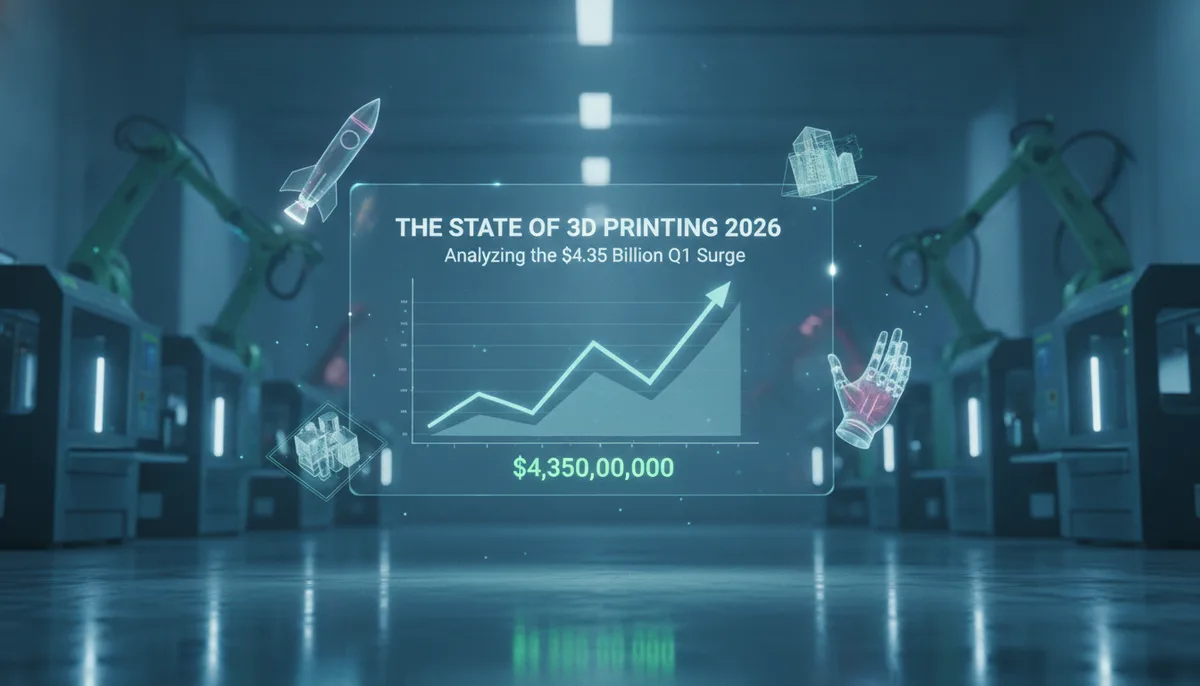
The State of 3D Printing 2026: Analyzing the $4.35 Billion Q1 Surge
The additive manufacturing (AM) landscape has officially shifted from a "future technology" to a cornerstone of modern industrial production. According to the latest data from Additive Manufacturing Research (AM Research or AMR), the 3D printing markets totaled a staggering $4.35 billion in the first quarter of 2026.
This figure represents more than just a financial milestone; it signals a fundamental change in how global supply chains operate. No longer confined to the labs of hobbyists or the prototyping departments of engineering firms, 3D printing has matured into a multi-billion dollar pillar of the manufacturing sector. As we dissect the implications of this $4.35 billion quarter, we see a story of material innovation, robotic integration, and a relentless drive toward decentralized production.
The $4.35 Billion Milestone: A New Era for Additive Manufacturing
The Q1 2026 report from AM Research highlights a market that is expanding both in breadth and depth. The $4.35 billion total encompasses hardware sales, material consumption, and specialized software services. What makes this growth particularly significant is the timing. Following years of "hype cycles," the industry has settled into a period of sustained, high-value utility.
Leading industry analysts point to the stabilization of industrial platforms as a primary reason for this surge. Companies are no longer buying one or two machines to "test the waters." Instead, they are investing in entire fleets of printers integrated directly into their assembly lines. This transition from "Rapid Prototyping" to "Additive Manufacturing" is the engine behind the record-breaking revenue seen in early 2026.
Key Drivers of the 2026 Market Surge
To understand how the market reached $4.35 billion in a single quarter, we must look at the specific technologies and materials that have moved the needle.
The Dominance of Industrial Metal Printing
Metal 3D printing has historically been the "high-end" segment of the market, but in 2026, it has become a primary revenue driver. The ability to print complex, flight-ready components or high-performance automotive parts has moved metal AM into the mainstream of heavy industry.
Innovations in alloys have played a crucial role here. For instance, the adoption of specialized materials like EOS Aluminium Constellium CP1: Revolutionizing Industrial Metal 3D Printing has allowed manufacturers to achieve thermal and mechanical properties that were previously impossible with traditional casting. These materials allow for the creation of lightweight, high-strength parts that are essential for the next generation of electric vehicles and aerospace hardware.
Polymer Production at Scale
While metal captures the headlines for its industrial might, polymers continue to represent a massive volume of the market. The shift here has been from "visual models" to "functional end-use parts." Engineering-grade resins and high-performance thermoplastics (like PEEK and PEI) are now being used for everything from customized medical housings to interior components in commercial aircraft.
For those looking to achieve professional results at a smaller scale, choosing the right materials is more critical than ever. The diversity of the market is reflected in our guide on the 10 Best 3D Printing Resins for Detail and Durability: A Maker’s Guide, which highlights how even consumer-accessible materials are reaching industrial-grade standards.
Automation and the Robotic Revolution
One of the most profound shifts noted in the 2026 data is the integration of robotics into the 3D printing workflow. The "Gantry" system, while still the standard for desktop units, is being supplemented—and in some cases replaced—by multi-axis robotic arms in industrial settings.
This evolution is critical for scaling. Robotic 3D printing allows for larger build volumes, non-planar printing (printing on curved surfaces), and the seamless integration of post-processing tasks like milling or polishing. Platforms like Addidex Connect are at the forefront of this movement, bridging the gap between digital design and physical execution. For a deeper look at how this technology is changing the factory floor, see our feature on Beyond the Gantry: How Addidex Connect is Championing the Robotic 3D Printing Revolution.
Sector Breakdown: Where the Capital is Flowing
The $4.35 billion in Q1 2026 revenue is not distributed evenly across all sectors. Certain industries are leading the charge, fueled by specific needs for customization and supply chain resilience.
Aerospace and Defense
Aerospace remains the largest consumer of high-end AM services. The drive for "part consolidation"—turning an assembly of 50 parts into a single 3D-printed component—saves weight and reduces failure points. In 2026, we are seeing more "flight-certified" 3D-printed parts than ever before, moving from secondary brackets to primary engine components.
Healthcare and Personalized Medicine
The medical sector has seen a surge in "Point of Care" manufacturing. Hospitals are increasingly housing their own 3D printing labs to create patient-specific surgical guides, anatomical models, and even custom prosthetics. This localized production reduces costs and improves patient outcomes, contributing significantly to the Q1 market totals.
Automotive and Tooling
While mass-market cars still rely heavily on traditional manufacturing, the "tooling" for those cars is now almost entirely 3D printed. Jigs, fixtures, and molds can be produced in hours rather than weeks, allowing automotive giants to pivot their assembly lines with unprecedented speed.
What This Means for Small Businesses and Makers
The massive growth at the industrial level has a "trickle-down" effect that benefits the entire ecosystem. As industrial players demand better materials and more reliable hardware, the technology becomes more affordable and accessible for small businesses and individual makers.
- Material Accessibility: High-performance filaments and resins that were exclusive to aerospace five years ago are now available for desktop printers.
- Software Sophistication: The AI-driven slicing software developed for $500,000 industrial machines is finding its way into open-source and consumer-grade applications, making it easier to achieve "first-time-right" prints.
- Service Bureau Expansion: With the market at $4.35 billion, the infrastructure of service bureaus has expanded. Small businesses can now outsource high-end metal or SLS (Selective Laser Sintering) prints with faster turnaround times and lower costs.
However, as the technology becomes more powerful, the need for safety and environmental control grows. Whether you are running a single machine or a small farm, maintaining the right environment is crucial for both part quality and operator health. If you are scaling your setup, consider whether an enclosure is necessary for your 3D printer to manage fumes and temperature fluctuations.
The Road to Q4 and Beyond
The AM Research report for Q1 2026 is a "canary in the coal mine" for the rest of the manufacturing world. If the first quarter has already hit $4.35 billion, the industry is on track for a record-breaking year that could see the total market value approach $20 billion.
The focus for the remainder of 2026 will likely be on "Standardization." For 3D printing to move into the next phase of growth, global standards for material properties and part certification must be finalized. This will allow industries like oil and gas or nuclear energy to adopt AM with the same confidence as the aerospace sector.
For the professional maker and the industrial engineer alike, the message is clear: Additive manufacturing is no longer an experimental peripheral. It is a core competency of the 21st-century economy. As we move through 2026, those who understand how to leverage these $4.35 billion worth of tools and materials will be the ones who lead the next industrial revolution.