
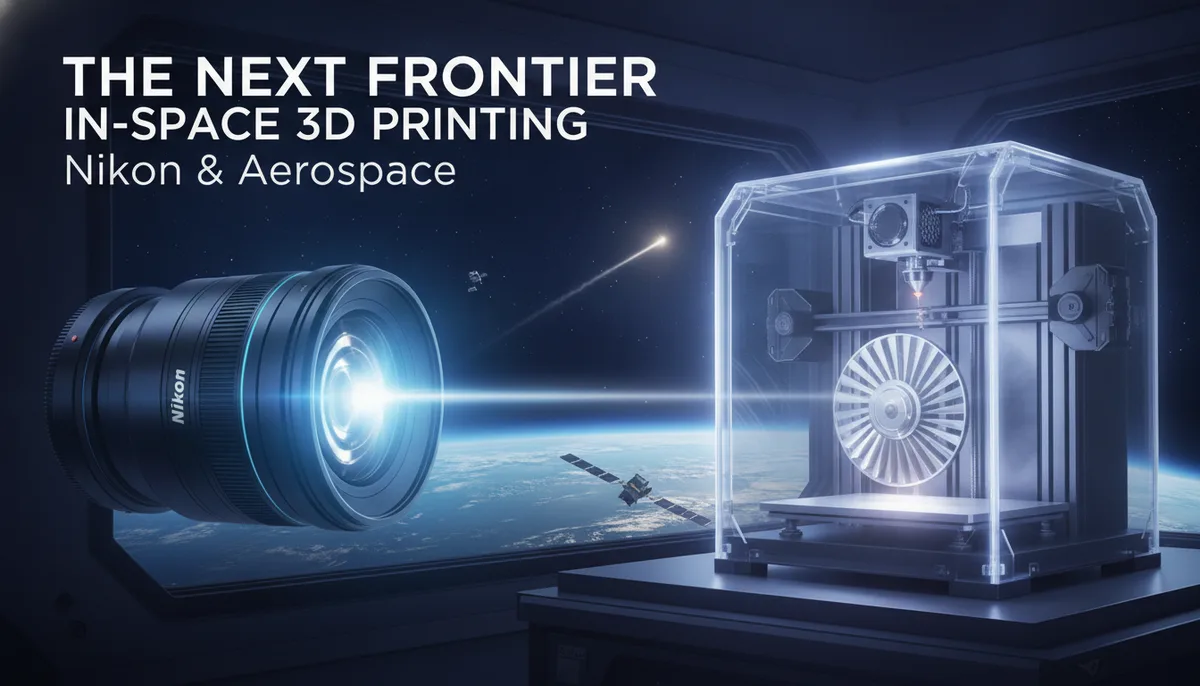
The Next Frontier: Why Nikon and the Aerospace Industry are Betting on In-Space 3D Printing
The aerospace industry has always been defined by a singular, punishing constraint: the cost of weight. For decades, the rule of thumb has been that every additional kilogram of payload requires an exponential increase in fuel, engine thrust, and structural support. In the current market, launching a single kilogram into Low Earth Orbit (LEO) can cost anywhere from $1,500 to $20,000 depending on the launch vehicle and mission profile.
To combat these costs, engineers have historically relied on subtractive manufacturing—milling away material from solid blocks of metal to create lightweight "isogrid" structures. However, we have reached the limit of what traditional machining can achieve. This is where Nikon Advanced Manufacturing and the broader additive manufacturing (AM) sector are stepping in to define the next frontier. The goal is no longer just making parts lighter on Earth; it is about producing them in the stars.
The Economics of Mass and the Additive Solution
The shift toward 3D printing in aerospace isn't just a technological preference; it’s an economic necessity. When every gram counts, the ability to place material only where it is mechanically required is a game-changer.
Traditional manufacturing often results in "buy-to-fly" ratios that are incredibly inefficient. In some aerospace components, 90% of a raw titanium block might be machined away and turned into scrap to produce a finished part. Additive manufacturing flips this script. By building parts layer-by-layer, AM reduces waste and allows for complex geometries like internal lattices and honeycomb structures that are impossible to mill.
Nikon’s strategic pivot into this space—highlighted by their acquisition of SLM Solutions and Morf3D—signals a transition from being a leader in optics to becoming a powerhouse in precision metal fabrication. By leveraging Laser Powder Bed Fusion (L-PBF), Nikon is enabling engineers to consolidate dozens of separate components into a single, 3D-printed assembly. This "part consolidation" reduces the number of fasteners, seals, and failure points, further driving down the weight and increasing the reliability of the spacecraft.
High-Performance Materials for the Vacuum of Space
For a 3D-printed part to survive the rigors of space, the material science must be flawless. The vacuum of space, extreme thermal cycling (ranging from hundreds of degrees Celsius in the sun to deep freeze in the shade), and high radiation levels require specialized alloys.
Metal 3D printing has evolved to handle these demands. We are seeing a surge in the use of specialized aluminum and titanium alloys that offer high strength-to-weight ratios. For instance, the EOS Aluminium Constellium CP1: Revolutionizing Industrial Metal 3D Printing has become a benchmark for high-performance applications, offering a unique combination of thermal conductivity and mechanical strength that is vital for satellite heat exchangers and structural brackets.
Metal 3D Printing Materials and Metallurgy Textbook
Beyond aluminum, nickel-based superalloys (like Inconel 718) are frequently used for rocket engine components, such as injectors and combustion chambers. These parts must withstand immense pressure and heat, and 3D printing allows for the integration of complex internal cooling channels that keep the engine from melting during ascent.
Quality Assurance in High-Stakes Environments
In the space industry, there is no "repair man." If a 3D-printed bracket on a satellite fails 22,000 miles away in geostationary orbit, the multi-million dollar mission could be a total loss. This makes Quality Assurance (QA) the most significant hurdle for the widespread adoption of AM in space.
Nikon’s expertise in metrology and precision imaging is a natural fit here. The industry is moving toward "in-situ" monitoring, where sensors track the melt pool of the laser in real-time to detect defects as they happen. This is similar to the work being done by Phase3D and the Air Force: Revolutionizing CMC 3D Printing with Real-Time Inspection, which focuses on ensuring that every layer of a build meets rigorous safety standards.
By integrating high-resolution cameras and AI-driven analysis into the printing process, manufacturers can certify parts as they are being built. This reduces the need for expensive post-process X-ray or CT scanning, accelerating the production timeline for urgent space missions.
From Earth-Bound Printing to Orbital Manufacturing
While Nikon and its subsidiaries are currently focused on optimizing manufacturing on the ground, the "next frontier" mentioned by industry leaders involves moving the printers themselves into orbit.
Orbital manufacturing presents a radical opportunity. On Earth, parts must be designed to withstand "1G" of gravity plus the violent vibrations of a rocket launch (often exceeding 3-5Gs). If we can print structures directly in the microgravity of space, we can design them to be incredibly thin and light, as they will never have to support their own weight under Earth's gravity or survive a launch.
Imagine a satellite with a 100-meter-wide antenna. Launching such a structure from Earth would require complex folding mechanisms that often fail. Printing that antenna in orbit allows for a seamless, lightweight structure that can be scaled far beyond the dimensions of a rocket’s fairing.
Professional Grade 3D Printing Enclosures and Filtration Systems
The Role of Generative Design
To truly capitalize on the capabilities of Nikon’s advanced hardware, the software side of the equation—Generative Design—is essential. Generative design uses AI algorithms to iterate through thousands of design possibilities based on specific constraints (e.g., "this bracket must hold 500kg of force but weigh less than 200g").
The resulting shapes often look organic or "bony." These biomimetic designs are perfect for 3D printing but impossible to manufacture any other way. By combining Nikon’s precision L-PBF machines with generative design, aerospace companies are achieving mass savings of up to 40-60% on critical structural components.
Challenges on the Horizon
Despite the optimism, the path to the stars is not without friction. Several challenges remain:
- Standardization: Unlike traditional forging or casting, the AM industry still lacks universal standards for part certification. Every aerospace company currently has its own proprietary "recipe" for printing flight-ready parts.
- Powder Management in Microgravity: Current metal 3D printing relies on gravity to spread thin layers of powder. In space, managing fine metallic powders is a safety hazard and a technical nightmare. This is pushing research into "wire-fed" Directed Energy Deposition (DED) systems, which are more suited for microgravity.
- Scalability: While we can print small, complex parts, printing large-scale rocket fuselages or space station modules remains a slow and energy-intensive process.
Conclusion: A New Era of Exploration
The partnership between precision optics giants like Nikon and the additive manufacturing sector marks a turning point for space exploration. We are moving away from the era of "disposable" rockets and heavy, over-engineered satellites toward a future of lean, optimized, and eventually, space-born hardware.
As we look toward permanent lunar bases and Mars missions, the ability to manufacture tools, spare parts, and infrastructure on-site will be the difference between success and failure. The "Next Frontier" isn't just a place we are going; it's a way of making the things that will take us there.
High-Temperature 3D Printing Filaments for Aerospace Prototyping