
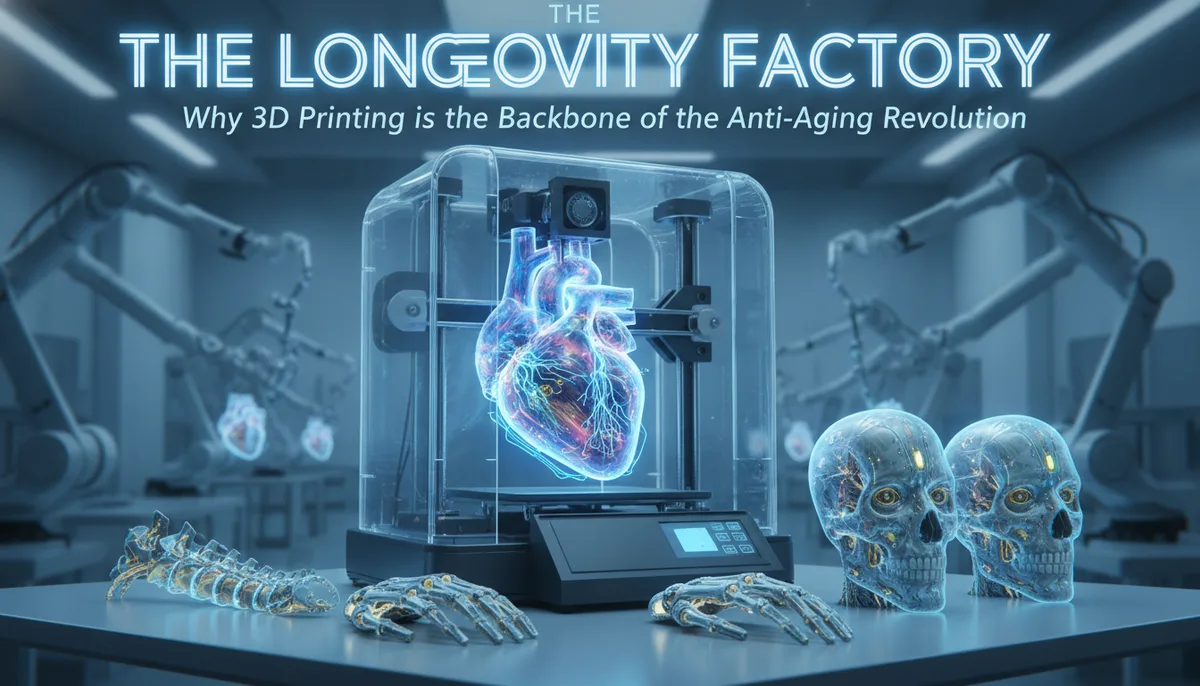
The Longevity Factory: Why 3D Printing is the Backbone of the Anti-Aging Revolution
The dream of extending the human lifespan has moved from the realm of science fiction into the boardroom. Every week, the healthcare sector is flooded with announcements regarding breakthrough anti-aging therapies, AI-driven drug discovery platforms, and well-funded startups promising to "solve" death. However, there is a growing realization among industry experts: the longevity economy is currently a brain without a body.
While the research is moving at breakneck speed, the physical infrastructure to deliver these breakthroughs to billions of people is lagging behind. To turn the promise of life extension into a reality, the longevity economy needs a factory. Not a 20th-century assembly line, but a digital, agile, and highly personalized manufacturing hub. This is where 3D printing, or additive manufacturing (AM), steps in as the critical missing link.
The Rise of the Longevity Economy
Longevity has become one of the biggest stories in healthcare. It is no longer just about adding years to life, but adding "healthspan"—the period of life spent in good health. This shift has birthed the "Longevity Economy," a sector projected to be worth trillions of dollars as the global population ages.
The current surge is driven by three main pillars:
- AI-Powered Discovery: Machine learning models are identifying compounds that can slow cellular aging.
- Biotechnology: Gene editing and regenerative medicine are targeting the root causes of age-related decline.
- Personalized Data: Wearables and biological testing allow for health interventions tailored to an individual’s unique biomarkers.
Despite these advancements, a bottleneck remains. If a scientist discovers a personalized stem-cell therapy or a custom-designed implant to repair an aging joint, how is it produced at scale? Traditional manufacturing is built for volume, not variety. The longevity economy requires the opposite: high-complexity, low-volume, and hyper-personalized production.
Why Traditional Manufacturing Fails the Longevity Test
For decades, the medical industry has relied on mass production. If you need a hip replacement or a heart stent, you generally receive a "standard" size that is "close enough" to your anatomy. In the context of longevity—where the goal is optimal biological function—"close enough" is no longer acceptable.
Traditional factories are rigid. Setting up a production line for a new medical device can take years and cost millions. This rigidity is the antithesis of the longevity movement, which thrives on rapid iteration and biological specificity. To support therapies that might change based on a patient’s evolving blood work or genetic expression, we need a manufacturing process that can pivot in hours, not months.
This is why the industry is looking toward additive manufacturing. By using 3D printing, we can move from "centralized mass production" to "distributed personalized production."
3D Printing: The Agile Factory for Life Extension
3D printing is uniquely suited to be the "factory" for the longevity economy because it treats complexity as a free variable. Whether you are printing a simple plastic prototype or a complex lattice structure for bone regrowth, the cost and time remain relatively stable.
Bioprinting and Regenerative Medicine
The most direct application of 3D printing in longevity is bioprinting. This involves using "bio-inks"—materials infused with living cells—to print tissues and, eventually, organs. As we age, our organs inevitably degrade. The ability to print a replacement patch for a scarred heart or a functional piece of liver tissue could add decades to a patient's life.
Currently, 3D bioprinting is being used to create "organs-on-a-chip." These are micro-scale models of human organs that allow researchers to test anti-aging drugs on actual human tissue without risking a patient's safety. This accelerates the "Longevity Factory" by shortening the feedback loop between discovery and application.
Personalized Drug Delivery
Longevity isn't just about surgery; it's about chemistry. Many anti-aging protocols involve complex "stacks" of supplements and medications. 3D printing allows for the creation of "polypills"—a single tablet containing multiple medications, each released at a specific time and dosage tailored to the individual. This level of precision ensures maximum efficacy while minimizing the side effects that often plague elderly patients taking multiple disparate medications.
Scaling Innovation through Global Investment
The transition to this new manufacturing paradigm requires significant capital and government support. We are already seeing nations position themselves to lead this charge. For example, Australia’s $3.25 Million Boost for 3D Printing represents a strategic move to empower small and medium enterprises (SMEs) to innovate within the additive space.
This type of funding is crucial because the "Longevity Factory" will likely not be one giant building. Instead, it will be a network of specialized SMEs using advanced 3D printers to produce localized solutions. By lowering the barrier to entry for these firms, we accelerate the deployment of life-saving technologies.
Material Science: The Fuel for the Longevity Engine
A factory is only as good as its raw materials. In the world of 3D printing, the development of new filaments and resins is what expands the boundaries of what is possible. In the healthcare sector, this means moving beyond simple plastics to biocompatible, bioresorbable, and even "smart" materials that can respond to the body's internal environment.
Recent industry updates, such as those found in the 3D Printing News Briefs July 2026, highlight the rapid pace of material innovation. Companies like Markforged are pushing the envelope with materials that offer the strength of metal with the flexibility of polymers, which is essential for creating durable, long-lasting internal prosthetics that can survive inside the human body for decades.
The Role of AI in the 3D Printed Factory
The synergy between AI and 3D printing is the "secret sauce" of the longevity economy. AI doesn't just help discover the drugs; it helps design the hardware. Generative design—a process where AI creates optimized shapes based on specific constraints—is being used to create bone scaffolds that are lighter and stronger than anything a human could design.
When an AI identifies a specific biological need in a patient, it can automatically generate a 3D-printable file for a custom implant or delivery device. The "factory" then receives this digital instruction and prints the physical object immediately. This "digital-to-physical" pipeline is the only way to manage the sheer scale of the aging global population.
Challenges to Overcome
Despite the potential, the path to a fully realized longevity factory is not without hurdles:
- Regulatory Frameworks: The FDA and other bodies are built for mass-produced goods. Approving a "process" (like a 3D printer) rather than a "product" (like a specific pill) requires a total overhaul of medical regulations.
- Standardization: For a distributed network of 3D printers to work, a file printed in Sydney must be identical to one printed in New York. This requires rigorous hardware and material standards.
- Cost of Entry: While 3D printing is cheaper for low volumes, the initial investment in high-end bioprinters and metal AM systems remains high for many healthcare providers.
Conclusion: Building the Future of Human Health
The longevity economy is more than just a trend; it is the next frontier of human evolution. However, to move from "research" to "results," we must build the infrastructure that can support personalized, agile, and complex manufacturing.
3D printing is that infrastructure. By acting as the factory for the longevity economy, additive manufacturing will allow us to print the future of healthcare—one personalized organ, pill, and implant at a time. As we continue to see investment and material innovation grow, the gap between the lab and the clinic will shrink, bringing us closer to a world where age is truly just a number.