
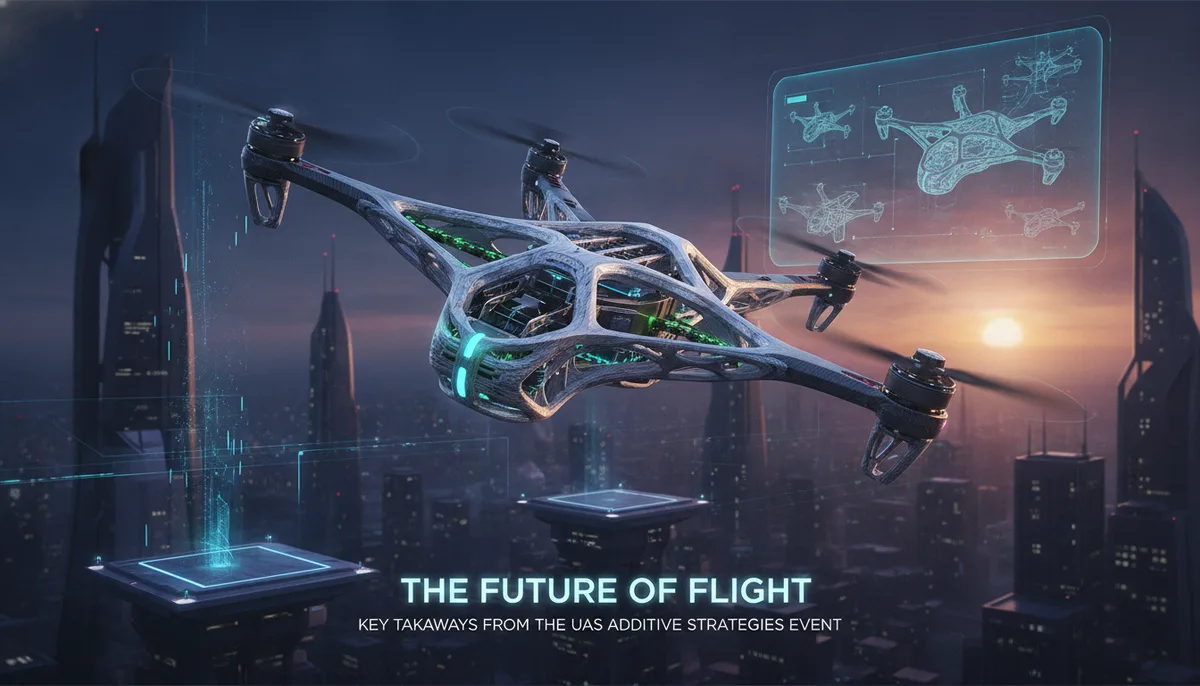
The Future of Flight: Key Takeaways from the UAS Additive Strategies Event
The intersection of Unmanned Aerial Systems (UAS) and additive manufacturing (AM) has moved well beyond the realm of experimental hobbyism. As highlighted in the recent UAS Additive Strategies online event, hosted by 3DPrint.com and Additive Manufacturing Research (AM Research), the drone industry is currently undergoing a radical transformation. This event brought together the brightest minds in aerospace and 3D printing to discuss how the ability to "print flight" is reshaping global supply chains, defense strategies, and commercial logistics.
For those tracking the evolution of the industry, the message was clear: 3D printing is no longer just a tool for making prototypes. It is now the backbone of a more agile, resilient, and technologically advanced drone ecosystem.
The Shift from Prototyping to Agile Production
Historically, the drone industry relied on traditional manufacturing methods like injection molding or CNC machining. While effective for mass production, these methods are notoriously rigid. If a design needs a slight adjustment to improve aerodynamics or accommodate a new sensor, the cost of re-tooling can be prohibitive.
The UAS Additive Strategies event emphasized that additive manufacturing eliminates these bottlenecks. In the world of UAS, where technology moves at breakneck speeds, the ability to iterate designs in hours rather than months is a competitive necessity. This "agile production" allows manufacturers to respond to real-world feedback instantly. Whether it is a commercial delivery drone needing a more robust landing gear or a reconnaissance drone requiring a specialized camera mount, 3D printing provides the flexibility to adapt without the overhead of traditional manufacturing.
For professionals looking to achieve this level of detail and structural integrity in their own builds, choosing the right medium is essential. You can explore the nuances of high-performance materials in our guide on the 10 Best 3D Printing Resins for Detail and Durability: A Maker’s Guide.
Material Science: Engineering the Perfect Lift
One of the most significant deep dives during the event centered on material science. A drone's performance is a delicate balance between weight and strength. Every gram saved in the frame is a gram that can be added to the battery or payload.
High-Performance Polymers and Composites
Speakers at the event pointed out that we are seeing a shift toward advanced composites. Carbon fiber-reinforced filaments and high-temperature thermoplastics like PEEK and PEI (Ultem) are becoming the standard for structural components. These materials offer the rigidity of aluminum but at a fraction of the weight.
Resins and Micro-UAS
For smaller drones or intricate internal components, SLA and DLP printing technologies are being utilized to create parts with tolerances that were previously impossible. These resins are being engineered to withstand the vibrations and thermal stresses associated with high-speed flight.
When deciding which material path to take for your drone components, the choice often comes down to the specific environment the craft will inhabit. For those just starting to experiment with drone frames, understanding the fundamentals of filament selection is key. Check out our comparison on PLA vs PETG: Which Filament Should You Start With? to understand how these entry-level materials behave under stress.
Distributed Manufacturing: Solving the Logistics Nightmare
Perhaps the most disruptive concept discussed at the UAS Additive Strategies event was distributed manufacturing. In traditional models, drones are built in a central factory and shipped globally. This creates a "single point of failure" in the supply chain. If a shipping lane is blocked or a factory is offline, the entire operation halts.
Additive manufacturing allows for a "digital inventory." Instead of shipping physical parts, companies can ship digital CAD files to local 3D printing hubs. This is particularly vital in:
- Defense Applications: Soldiers in the field can print replacement parts for damaged drones on-site, rather than waiting weeks for a resupply.
- Remote Commercial Operations: Mining or agricultural operations in remote areas can maintain their drone fleets with minimal downtime.
- Disaster Relief: Rapidly deploying drones for search and rescue by printing them at the edge of the disaster zone.
This movement toward decentralized production is being supported by massive infrastructure investments globally. For instance, Australia’s $3.25 Million Boost for 3D Printing is a prime example of how governments are recognizing the strategic importance of localized additive capabilities.
The Role of Robotics and Automation in UAS Assembly
As the demand for drones scales, the industry is looking beyond the standard desktop 3D printer. The event highlighted the rise of robotic 3D printing—using multi-axis robotic arms to print large-scale drone fuselages and wings.
Robotic AM allows for "non-planar" printing, meaning the printer can lay down material along the curves of a wing, significantly increasing the part's strength compared to traditional layer-by-layer horizontal printing. This technology is bridging the gap between small-scale part production and the manufacturing of entire airframes.
This evolution in hardware is often discussed in the context of "Beyond the Gantry" systems, which free the printing process from the constraints of a traditional box-shaped printer. For a deeper look at how these robotic systems are changing the landscape, see our feature on Beyond the Gantry: How Addidex Connect is Championing the Robotic 3D Printing Revolution.
Defense and the "Attritable" Drone Strategy
A major theme of the UAS Additive Strategies event was the concept of "attritable" drones—low-cost, high-performance aircraft designed for a limited number of missions. In modern conflict, the goal is often to overwhelm an adversary with sheer numbers. 3D printing is the only technology capable of producing these complex machines at a cost low enough to treat them as semi-disposable.
The defense sector is currently the largest driver of innovation in this space. By utilizing AM, defense contractors can reduce the part count of a drone from hundreds of pieces to just a dozen integrated components. This not only makes the drone lighter and faster but also significantly easier to assemble in high-pressure environments.
Regulatory Hurdles and the Path to Certification
While the technology is moving fast, the regulatory environment is still catching up. The event did not shy away from the challenges of certification. For a 3D-printed drone to fly in commercial airspace, every part must be traceable, and every material must be flight-certified.
The industry is currently working on "digital twins" and in-situ monitoring. This involves using sensors inside the 3D printer to monitor the build in real-time, ensuring that there are no microscopic defects in the layers. This data-driven approach to quality control is what will eventually allow 3D-printed drones to carry passengers or deliver critical medical supplies in urban environments.
Looking Ahead: The 2030 Vision
The UAS Additive Strategies event served as a roadmap for the next decade. We are moving toward a future where drones are not just "made," but "grown" through additive processes that mimic biological efficiency. With the integration of AI-driven generative design, we will see drone frames that look more like bone structures than traditional machines—optimized by algorithms for maximum strength and minimum weight.
As we see in the 3D Printing News Briefs July 2026, the leadership in organizations like AMUG and innovations from companies like Markforged are constantly pushing the boundaries of what these machines can do.
For the maker, the engineer, and the defense strategist, the takeaway is simple: the future of flight is additive. Those who master the materials and the machines today will be the ones defining the skies of tomorrow.