
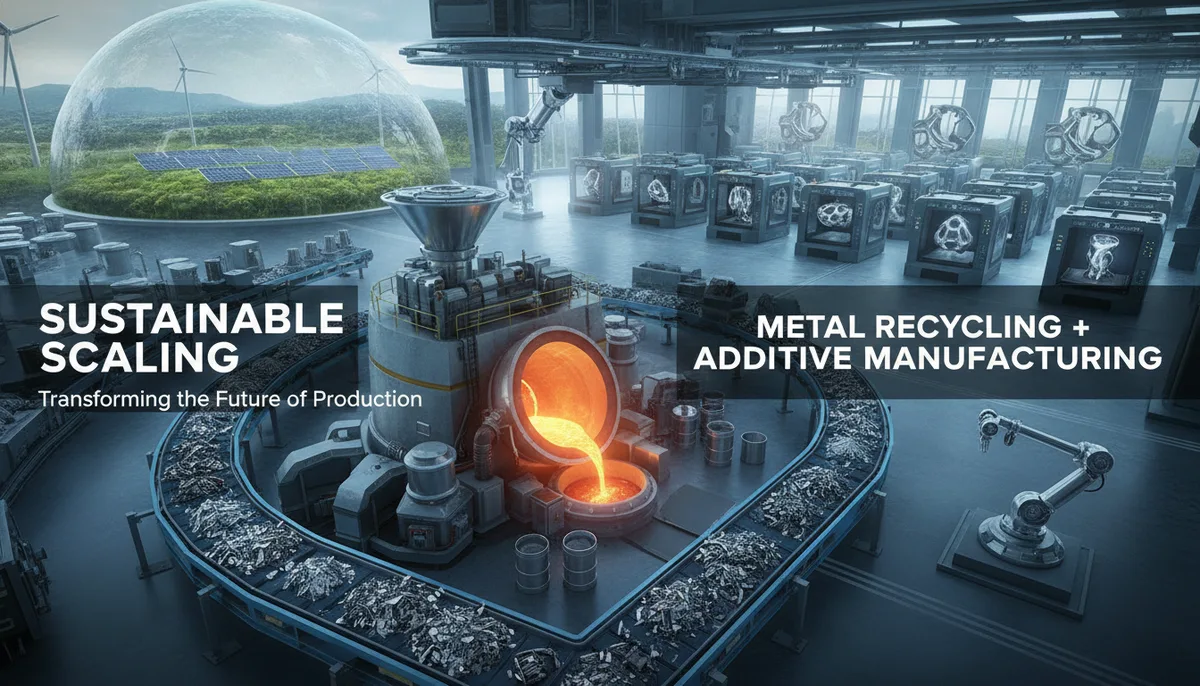
Sustainable Scaling: How Metal Recycling is Transforming Additive Manufacturing
The additive manufacturing (AM) industry is no longer in its infancy. We have moved past the era of simple prototyping into a phase of high-volume industrial production. However, as metal 3D printing scales, it faces a fundamental logistical hurdle: the "powder problem."
To sustain the growth of the industry, we need an astronomical amount of high-purity metal powder. Traditionally, this material has been sourced from virgin ores—a process that is expensive, energy-intensive, and vulnerable to geopolitical supply chain disruptions. A recent white paper from Continuum and AM Research highlights a pivotal shift in the industry, suggesting that the future of metal AM isn't just in the machines themselves, but in how we source the materials that feed them.
The Scaling Challenge: Why Virgin Material Isn’t Enough
The growth of metal additive manufacturing is driven by the demand for complex, lightweight parts in aerospace, automotive, and medical sectors. As companies transition from operating a single machine to managing "printer farms," their material consumption increases exponentially.
Virgin metal powder production involves mining, refining, and atomization. This linear "take-make-waste" model presents three primary risks to the scaling of AM:
- Cost Volatility: The price of virgin titanium, nickel, and cobalt is tied to global mining outputs and trade policies. For AM to compete with traditional casting or machining, the total cost of ownership must come down.
- Environmental Impact: Heavy industry is under increasing pressure to decarbonize. The carbon footprint of mining and smelting virgin ores is massive compared to the energy required to re-process existing scrap.
- Supply Chain Fragility: Relying on a few global sources for raw materials creates a single point of failure.
By shifting toward a circular economy—where scrap metal, supports, and failed prints are recycled back into high-quality powder—the industry can insulate itself from these risks.
The Science of High-Purity Metal Recycling
A common misconception is that "recycled" means "lower quality." In the context of industrial 3D printing, this couldn't be further from the truth. The white paper from Continuum emphasizes that the goal is not just to reuse material, but to refine it to a state that is indistinguishable from, or even superior to, virgin powder.
The process often involves advanced plasma atomization. This technology takes metal scrap—which could be anything from CNC turnings to old 3D-printed supports—and melts it in a high-energy plasma field. The result is perfectly spherical powder particles with highly controlled grain structures.
For high-performance applications, such as those using EOS Aluminium Constellium CP1: Revolutionizing Industrial Metal 3D Printing, maintaining the chemical integrity of the alloy is paramount. Modern recycling processes can remove impurities and adjust chemical compositions during the melting phase, ensuring the final powder meets strict ASTM and ISO standards.
industrial metal powder sieving station
The Economic Case for Circularity in AM
For a business, the decision to move toward recycled materials is rarely just about "being green"—it’s about the bottom line. The AM Research white paper points out that metal recycling creates a "closed-loop" system that significantly reduces waste.
In a typical metal 3D printing process, a significant portion of the material does not end up in the final part. Support structures, overflow powder, and the occasional failed build represent "sunk costs" if they are simply discarded or sold as low-value scrap.
By implementing a recycling strategy, companies can:
- Lower Material Costs: Sourcing powder from their own scrap or certified recycled streams is often more cost-effective than buying 100% virgin material.
- Improve Resource Efficiency: Every kilogram of scrap that is turned back into powder is a kilogram that doesn't need to be purchased from a third-party vendor.
- Enhance Sustainability Ratings: Large OEMs (Original Equipment Manufacturers) are increasingly requiring their suppliers to provide data on the recycled content of their products to meet ESG (Environmental, Social, and Governance) goals.
Strategic Sourcing and the Role of Continuum
The partnership between material providers like Continuum and research firms like AM Research is crucial for establishing the infrastructure needed for this transition. Continuum focuses on the "how" of the circular economy, providing the technology to transform industrial waste into "OptiPowder."
This isn't just about melting down old parts. It involves a sophisticated logistics chain where scrap is sorted, cleaned, and analyzed before it ever reaches the atomization chamber. This level of rigor is what allows recycled powders to be used in flight-critical aerospace components or life-saving medical implants.
As we look at the broader landscape of automation, such as the developments discussed in Beyond the Gantry: How Addidex Connect is Championing the Robotic 3D Printing Revolution, it becomes clear that material handling and recycling will eventually be integrated into the robotic workflow of the factory floor.
Overcoming the "Recycling Stigma"
Despite the technical evidence, some engineers remain hesitant to use recycled powders. This "stigma" is a hurdle that the industry must overcome through transparent data and rigorous testing.
The AM Research white paper provides a framework for this validation. By comparing the mechanical properties—such as tensile strength, fatigue life, and porosity—of parts printed with virgin vs. recycled powder, the data consistently shows that high-quality recycled powder performs on par with its virgin counterparts.
In fact, because the plasma refining process can sometimes remove more oxygen and impurities than standard atomization, some recycled powders exhibit better flowability and higher purity levels than the "new" powder available on the market.
metal 3D printing ultrasonic cleaner for parts
The Future: A Self-Sustaining Industry
The ultimate goal for the additive manufacturing industry is to become self-sustaining. Imagine a future where a manufacturing hub produces zero metal waste. Every support structure removed from a titanium bracket is tossed into a bin, sent to a local refining center, and returned as fresh powder within the same week.
This vision isn't just a pipe dream; it's a necessity for the industry to reach its projected multi-billion dollar valuation. As the white paper suggests, the "Material Revolution" is the silent engine driving the "Additive Revolution."
For makers and industrial leaders alike, the message is clear: the value of your metal doesn't end when the print is finished. By embracing recycling and the circular economy, we aren't just saving the planet—we are building a more resilient, profitable, and scalable manufacturing future.
Practical Steps for Implementing Metal Circularity
If your organization is looking to integrate recycled materials or improve its scrap management, consider the following:
- Segregate Your Scrap: Never mix different alloys (e.g., keep 316L stainless separate from Inconel 718). Contamination is the enemy of recycling.
- Audit Your Waste Stream: Calculate how much weight you are losing to supports and failed prints. This is your "recycling potential."
- Partner with Certified Refiners: Work with companies like Continuum that provide full traceability and chemical analysis for their recycled powders.
- Update Procurement Standards: Start including "recycled content" as a preferred metric when sourcing powders for non-critical components to build internal confidence.
The growth of metal AM is inevitable, but its sustainability depends on our ability to rethink where our materials come from. The shift from virgin to recycled is no longer an option—it is the blueprint for the next decade of industrial innovation.