
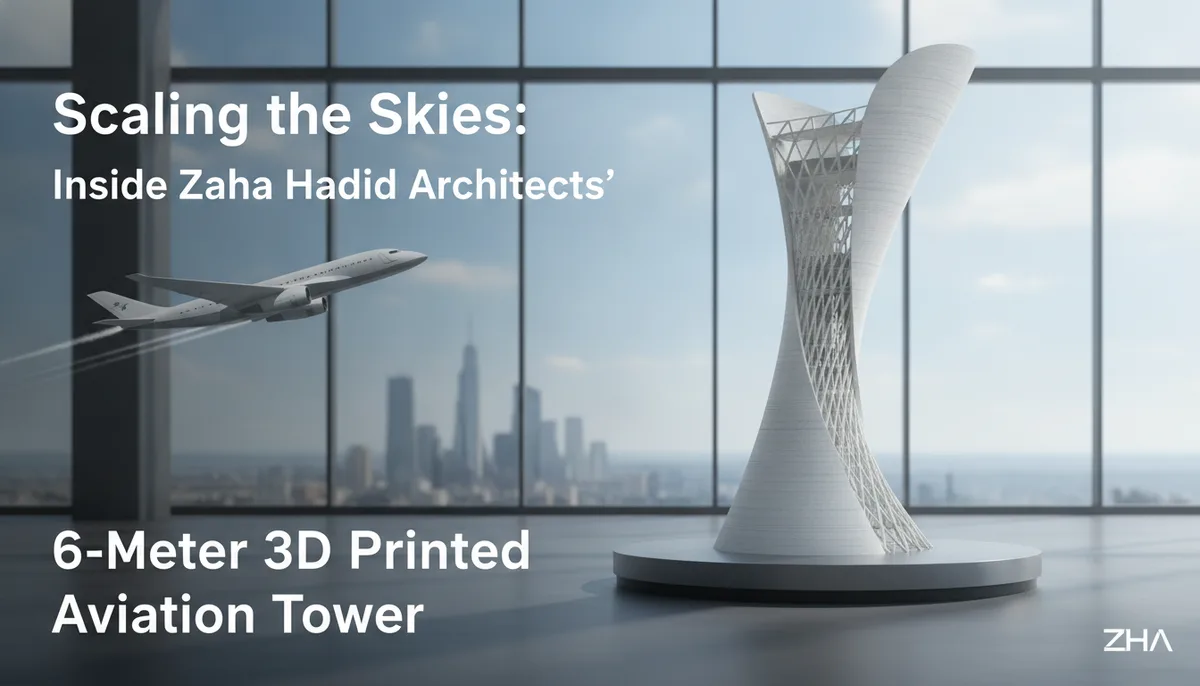
Scaling the Skies: Inside Zaha Hadid Architects’ 6-Meter 3D Printed Aviation Tower
---CONTENT:
The skyline of modern architecture has long been defined by the fluid, parametric curves of Zaha Hadid Architects (ZHA). From the Heydar Aliyev Center to the Beijing Daxing International Airport, the firm has consistently challenged the limits of geometry. However, their latest feat isn't a finished skyscraper, but a monumental leap in how those buildings are designed and prototyped.
ZHA’s internal "Tech Lab" recently completed a 6-meter-tall model of an aircraft control tower for the firm’s aviation-focused wing, ZHAviation. By leveraging the large-scale capabilities of WASP 3D printers, the team has demonstrated that additive manufacturing is no longer just for desktop trinkets—it is a primary tool for structural exploration at an architectural scale.
The Intersection of Fluidity and Fabrication
The hallmark of Zaha Hadid’s legacy is "Parametricism"—a design style where elements are interconnected and fluid rather than rigid and boxy. Achieving these shapes in a physical model has traditionally been a nightmare of manual labor, involving CNC milling, hand-sanding, and complex assembly.
By moving the fabrication of the 6-meter tower in-house, ZHA Tech Lab has bypassed the limitations of traditional model making. The use of WASP (World's Advanced Saving Project) printers allows the firm to translate digital algorithmic designs directly into physical forms. This "file-to-factory" workflow ensures that the subtle curvatures required for aerodynamic and aesthetic excellence in aviation infrastructure are preserved perfectly from the computer screen to the physical model.
Inside the ZHA Tech Lab: Where Computation Meets Plastic
The ZHA Tech Lab serves as the experimental heart of the firm. It is here that architects transition into makers, testing the structural viability of their designs. The creation of a 6-meter tower is not merely about size; it is about the precision of the layer deposition at that scale.
For a project of this magnitude, the choice of hardware is critical. The Tech Lab required a system capable of sustained, long-term printing without the common failures associated with smaller hobbyist machines.
Why In-House 3D Printing Matters for Modern Architecture
Having these capabilities in-house allows for a rapid iterative process. In the past, waiting for an external vendor to produce a large-scale model could take weeks or months. Now, the ZHAviation team can print segments, analyze the aesthetic impact, and make real-time adjustments to the digital twin. This synergy between the design team and the fabrication lab reduces the "translation error" that often occurs when a third party interprets architectural drawings.
The WASP Advantage: Scaling to Six Meters
The choice of WASP 3D printers is significant. WASP is renowned for its delta-style printers, which utilize three arms on a vertical rail system. Unlike traditional Cartesian printers (which move on X, Y, and Z axes), Delta printers are inherently better suited for tall, cylindrical, or tower-like structures.
The 6-meter tower model stands as a testament to the stability of the WASP platform. When printing at such heights, even a minor vibration at the base can lead to significant "sway" at the top, potentially ruining the print. The Tech Lab’s success highlights the maturity of large-format additive manufacturing (LFAM) in a professional studio environment.
Delta Kinematics and Vertical Ambition
The mechanical advantage of the Delta system is its speed and height-to-footprint ratio. Because the print head is lightweight and moved by three coordinated arms, it can achieve high speeds without the momentum-related shaking that plagues heavy gantry systems. For an architectural firm like ZHA, where time is a luxury, the ability to print tall components quickly is a game-changer.
Overcoming the Challenges of Large-Scale Modeling
Printing a 6-meter structure is not as simple as hitting "print" on a larger machine. It requires a deep understanding of material science and environmental control. At this scale, thermal contraction becomes a major enemy. As the plastic cools, it shrinks; if it shrinks unevenly, the entire tower could warp or delaminate.
To mitigate these risks, professional labs often utilize controlled environments. While the ZHA model is a feat of engineering, it also serves as a reminder for smaller firms that scaling up requires attention to detail regarding the print environment.
For those looking to achieve professional-grade results on a smaller scale, understanding the role of the environment is key. You can learn more about how to manage these variables in our guide: Is an Enclosure Necessary for Your 3D Printer? A Guide to Safety and Quality.
Structural Integrity at Scale
The 6-meter tower was likely printed in sections and then assembled, a common practice in large-scale architectural modeling. This allows for the use of different materials or infill densities depending on the structural needs of each segment. The base must support the weight of the entire 6-meter stack, requiring a higher density or a more rigid filament.
The Robotic Frontier in Architectural AM
The ZHAviation project is part of a broader trend where robotics and 3D printing are merging. We are moving "beyond the gantry," where the limits of the printer frame no longer define the limits of the building. Robotic arms equipped with extruders are now being used to print entire houses and bridges.
ZHA’s work with WASP is a stepping stone toward this robotic future. By mastering the software and hardware required for a 6-meter model, the firm is preparing for a future where the final buildings themselves are printed on-site. This evolution is explored in depth in our article on Beyond the Gantry: How Addidex Connect is Championing the Robotic 3D Printing Revolution.
From Model to Reality: The Future of ZHAviation
The aviation industry is currently undergoing a massive shift toward sustainability and smarter infrastructure. Control towers are the "brains" of the airport, and their design must balance visibility, technology integration, and iconic presence.
ZHAviation’s use of 3D printing for this 6-meter model allows them to test how light interacts with the tower’s facade and how the structure sits within the larger context of an airport's master plan. It provides a level of "physicality" that VR or AR cannot yet fully replicate. A 6-meter model allows architects to walk around the structure, viewing it from the same perspectives a passenger or pilot would.
Materiality and Sustainability in Architectural Prototyping
One of the often-overlooked benefits of using WASP technology is the potential for sustainable materials. WASP has a long history of experimenting with clay, soil, and recycled polymers. While the ZHAviation model likely used high-quality polymers for detail and durability, the methodology paves the way for using bio-plastics or recycled materials in future architectural prototypes, aligning with the global push for "Green Aviation."
Conclusion: A New Standard for Design Labs
The successful printing of a 6-meter aircraft control tower by Zaha Hadid Architects’ Tech Lab marks a pivotal moment for the industry. It proves that large-scale 3D printing is a viable, in-house solution for the world's leading design firms.
As we look toward the future of additive manufacturing, the lessons learned by ZHA will trickle down to the rest of the maker community. The bridge between a digital concept and a 6-meter physical reality is now shorter than ever. Whether it is through the use of Delta printers like those from WASP or the integration of robotic arms, the message is clear: in the world of 3D printing, the only remaining limit is our own imagination.
For those inspired by ZHA’s commitment to detail and durability, choosing the right materials for your own projects is the first step toward professional-grade results. Explore our curated list of the 10 Best 3D Printing Resins for Detail and Durability: A Maker’s Guide to find the perfect match for your next high-stakes print.