
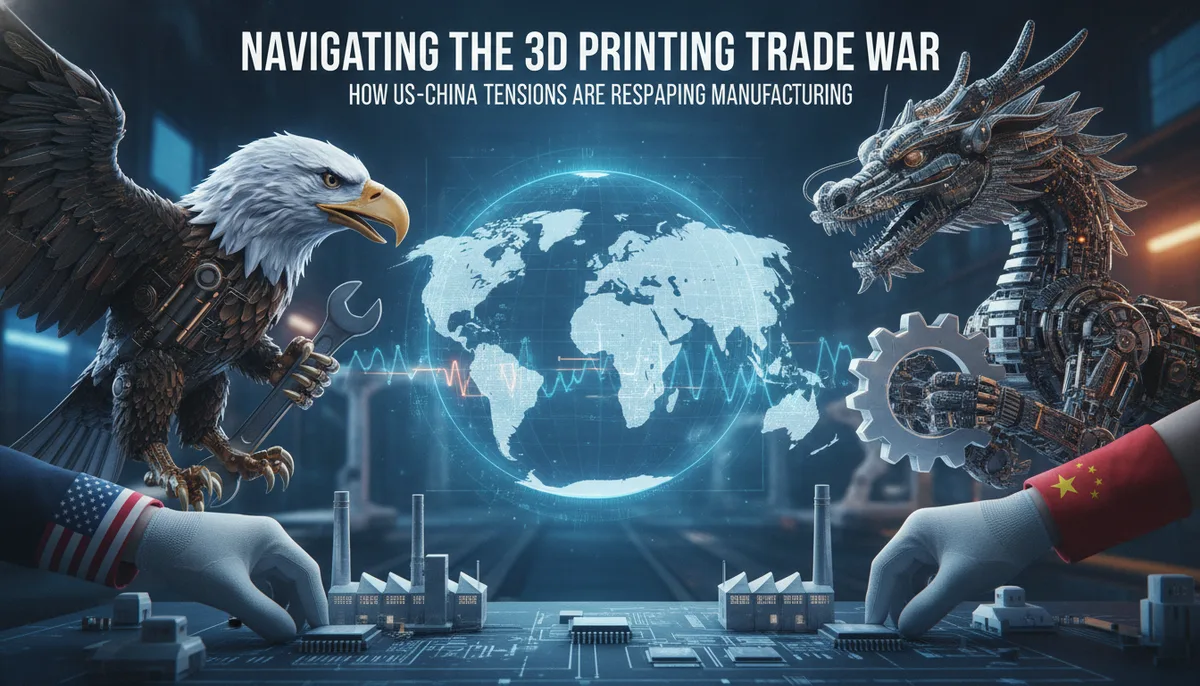
Navigating the 3D Printing Trade War: How US-China Tensions Are Reshaping Manufacturing
The global 3D printing landscape, once characterized by seamless international collaboration and the rapid proliferation of low-cost hardware, is entering a new, more fractured era. As the trade war between the United States and China intensifies, the additive manufacturing (AM) sector finds itself at the heart of a complex geopolitical struggle.
Western governments currently lack a truly coherent view on how to engage China on trade. They often vacillate between intimate economic cooperation and antagonistic bluster, depending on the political climate of the moment. This inconsistency creates a volatile environment for businesses that rely on Chinese innovation for hardware while simultaneously navigating Western mandates for security and domestic industrial growth.
The Geopolitical Seesaw: Cooperation vs. Confrontation
The central tension in the 3D printing market stems from the dual nature of China’s role. On one hand, China is a powerhouse of manufacturing efficiency, producing high-quality consumer and prosumer printers at prices that Western competitors struggle to match. On the other hand, the U.S. and its allies increasingly view China as a systemic rival, leading to policies aimed at "de-risking" essential technologies.
This vacillation—moving from deep economic integration to sudden tariff hikes—leaves 3D printing companies in a state of perpetual uncertainty. For instance, a company might invest heavily in a fleet of Chinese-made industrial printers only to face new tariffs or software restrictions six months later. This lack of a unified Western strategy makes long-term capital investment in additive manufacturing a high-stakes gamble.
The Shift Toward Strategic Autonomy and Reshoring
One of the most significant impacts of the trade war is the accelerated push for strategic autonomy. Western nations are realizing that over-reliance on foreign manufacturing for critical parts is a vulnerability. 3D printing is uniquely positioned to solve this problem by enabling "reshoring"—bringing manufacturing back to domestic soil.
By utilizing advanced systems, such as , companies can produce complex aerospace or medical components locally. This reduces the need for fragile trans-Pacific supply chains. The ability to print on demand means that a warehouse in Ohio no longer needs to wait for a shipment from Shenzhen to keep a production line moving.
In the realm of high-end materials, the shift is even more pronounced. Specialized alloys are becoming battlegrounds for export controls. For example, the development of EOS Aluminium Constellium CP1: Revolutionizing Industrial Metal 3D Printing highlights how Western innovation in material science is being leveraged to create high-performance parts that don't depend on restricted supply lines.
The Hardware Divide: Consumer Accessibility vs. National Security
The trade war has created a distinct divide between the consumer and industrial 3D printing sectors. In the consumer market, Chinese brands like Bambu Lab have revolutionized the industry with speed and ease of use. However, these advancements have come with increased scrutiny regarding data privacy and cloud security.
Western regulators are increasingly concerned about where 3D model data is stored and whether "connected" printers could serve as entry points for cyber interference. This has led to a surge in demand for "LAN-only" modes and offline-capable hardware. For users concerned about the longevity and security of their setups, investing in protective infrastructure is becoming standard.
Furthermore, the physical safety and quality of these machines remain a priority for Western users who may be operating them in less-regulated home environments. Understanding Is an Enclosure Necessary for Your 3D Printer? A Guide to Safety and Quality is essential for those balancing the cost-benefits of imported hardware with the safety standards expected in domestic workshops.
Automation as a Countermeasure to Labor Costs
Historically, the primary draw of Chinese manufacturing was low labor costs. As trade barriers rise, Western companies are turning to automation to close the price gap. The goal is to make domestic 3D printing as cost-effective as overseas mass production through the use of robotics and AI-driven workflows.
Innovations in robotic integration are changing the gantry-style limitations of traditional 3D printing. Projects like those seen in Beyond the Gantry: How Addidex Connect is Championing the Robotic 3D Printing Revolution demonstrate how Western firms are using multi-axis robotic arms to create larger, more complex structures with minimal human intervention. This shift toward "lights-out" manufacturing is a direct response to the need for competitive domestic production in a post-trade-war world.
Material Sovereignty: Resins and Powders
The trade war isn't just about the machines; it's about the "ink." China is a major exporter of the chemicals used in UV resins and the raw materials for metal powders. Tariffs on these consumables can significantly drive up the total cost of ownership for a 3D printing lab.
To mitigate this, there is a growing movement to certify and source resins from Western-aligned nations or domestic producers. This ensures that even if hardware imports are throttled, the ability to produce parts remains intact. For professionals, choosing high-quality, reliably sourced materials is more critical than ever.
When evaluating your material strategy, it is helpful to consult resources like the 10 Best 3D Printing Resins for Detail and Durability: A Maker’s Guide to find options that offer a balance of performance and supply chain stability.
The Future: A "China Plus One" Strategy?
Rather than a total decoupling, many industry experts predict the emergence of a "China Plus One" strategy. In this model, companies continue to utilize China’s massive 3D printing infrastructure for non-critical or cost-sensitive components while establishing parallel additive manufacturing capabilities in the U.S., Europe, or "friendly" nations like India or Vietnam.
This hybrid approach allows businesses to benefit from Chinese innovation while maintaining a "safety valve" in case of sudden geopolitical shifts. It also encourages a more competitive global market where Western companies are forced to innovate faster in areas like software integration, material science, and automated post-processing.
Conclusion: Adapting to the New Normal
The 3D printing market is no longer a neutral playground of technological advancement. It is a strategic theater where national security, economic policy, and innovation intersect. While the vacillating views of Western governments provide a challenging backdrop, they also present an opportunity for the AM industry to prove its worth as a pillar of resilient, domestic manufacturing.
For businesses and makers alike, the path forward involves a careful balance: leveraging the best global technology while building the local infrastructure necessary to withstand the next wave of trade volatility. Whether through investing in automated robotics or securing domestic material supplies, the goal is clear—ensuring that the power to create remains in your hands, regardless of the geopolitical winds.