
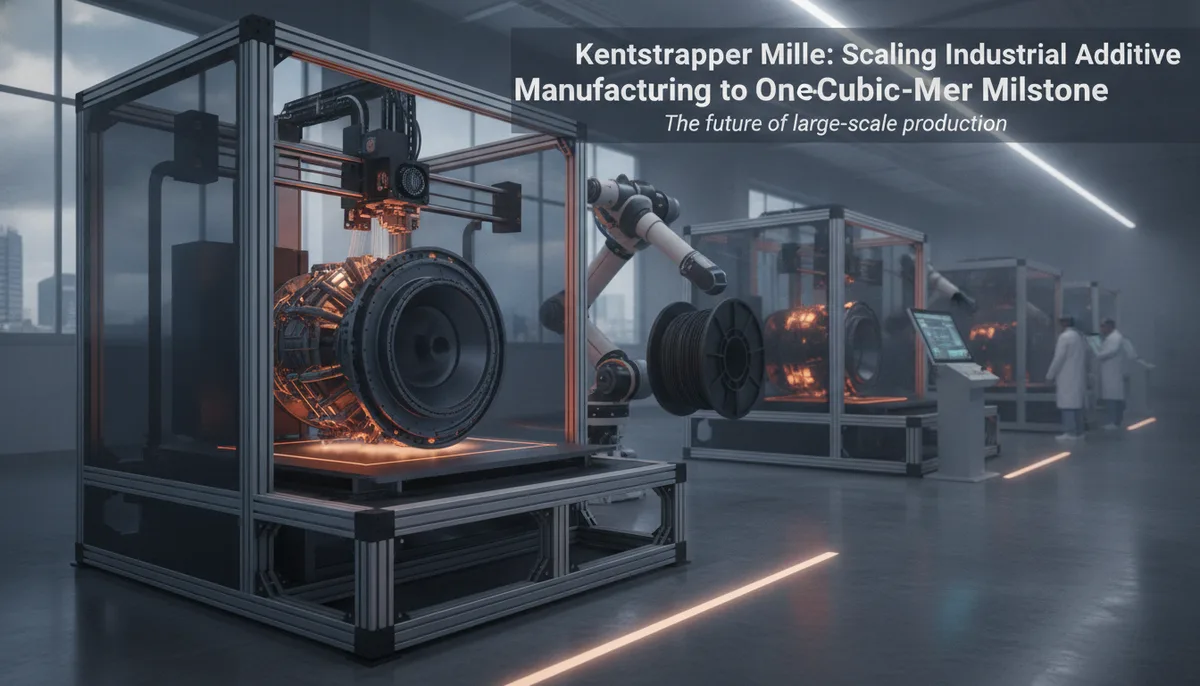
Kentstrapper Mille: Scaling Industrial Additive Manufacturing to the One-Cubic-Meter Milestone
The New Frontier of Large-Scale Additive Manufacturing (LSAM)
For years, the 3D printing industry has been locked in a race toward two extremes: microscopic precision and massive scale. While desktop printers have perfected the art of the hobbyist's benchy, the industrial sector has been clamoring for systems that can handle "real-world" dimensions without the astronomical price tags of aerospace-grade machinery.
Italy’s Kentstrapper has stepped into this gap with the release of the Mille, a material extrusion system that boasts a staggering 1,000 x 1,000 x 1,000 mm build volume. This one-cubic-meter threshold is more than just a round number; it represents a psychological and functional milestone in manufacturing. At this scale, 3D printing moves away from being a "part maker" and becomes a "system maker," capable of producing full-scale furniture, automotive body panels, and large-scale industrial tooling in a single, continuous print job.
The Mille arrives at a pivotal time. As discussed in our look at 3D Printing News Briefs July 2026: AMUG Leadership, DSH Technologies, and Markforged Material Innovations, the industry is shifting its focus toward material reliability and large-format accessibility. The Mille is Kentstrapper’s boldest statement yet in this evolving landscape.
Breaking Down the Kentstrapper Mille Specifications
The Mille is not merely a scaled-up desktop printer. Engineering a machine that can move an extruder across a meter-long gantry while maintaining micron-level accuracy requires a fundamental rethink of motion control and thermal management.
The Power of One Cubic Meter
The 1,000mm³ build volume is the headline feature, but the implications for workflow are the real story. In traditional manufacturing, a part that measures 900mm would require expensive CNC machining or the creation of a multi-part mold. In 3D printing, if your build plate is only 300mm, you are forced to slice the model into sections, print them individually, and then bond them together—a process that introduces structural weak points and labor-intensive finishing.
The Mille eliminates these "assembly seams." By providing a full cubic meter of space, Kentstrapper allows engineers to print monolithic structures. This is particularly valuable for jigs, fixtures, and vacuum forming molds where air-tight integrity and structural rigidity are paramount.
Thermal Management: The Actively Heated Chamber
Large-scale material extrusion faces a relentless enemy: physics. As plastic is extruded, it is molten; as it cools, it contracts. On a small print, this contraction is negligible. On a print that spans a meter, the cumulative force of that contraction can be enough to rip the part off the build plate or cause catastrophic interlayer delamination.
Kentstrapper addresses this by incorporating an actively heated build volume. Unlike "enclosed" printers that simply trap the heat from the bed, the Mille uses dedicated heating elements to maintain a consistent ambient temperature throughout the entire chamber. This environment keeps the plastic in a "stress-free" state during the duration of the print, only allowing it to cool and contract once the entire geometry is complete.
Why Active Heating Changes the Game for Industrial Polymers
The inclusion of an actively heated chamber allows the Mille to move beyond basic PLA and PETG. While those materials are excellent for prototyping, industrial applications often require the mechanical properties of ABS, ASA, Polycarbonate (PC), or Nylon.
These "engineering-grade" materials are notoriously difficult to print at scale because of their high shrink rates. By stabilizing the internal temperature, the Mille ensures that:
- Interlayer Adhesion is Optimized: The previous layer remains warm enough to create a molecular bond with the new layer.
- Dimensional Accuracy is Maintained: Parts do not warp or "banana" at the corners, ensuring that the 1,000mm part actually measures 1,000mm when it leaves the machine.
- Internal Stress is Reduced: Large parts are less likely to crack hours or days after the print is finished.
For those just starting their journey into material selection, understanding these thermal dynamics is key. You can learn more about the base characteristics of common filaments in our guide on PLA vs PETG: Which Filament Should You Start With?.
Economic Impact: The €40,000 Price Point in Context
At approximately €40,000, the Kentstrapper Mille is positioned as a "mid-market" industrial solution. To the uninitiated, this might seem high, but in the world of Large Scale Additive Manufacturing (LSAM), it is remarkably competitive.
Historically, if a company wanted a one-cubic-meter build volume with an actively heated chamber, they were looking at investments in the six-figure range. High-end systems from competitors often come with restrictive material ecosystems (proprietary filaments) and expensive service contracts.
Kentstrapper’s approach appears to favor an open-material philosophy, allowing businesses to source their own industrial filaments. This significantly lowers the Total Cost of Ownership (TCO). For a Small to Medium Enterprise (SME), the Mille represents a path to "in-housing" large-scale production that was previously outsourced to expensive service bureaus.
Targeted Applications: From Tooling to End-Use Parts
Who is the Mille for? The versatility of a one-meter build volume opens doors across several high-value industries:
1. Automotive and Transportation
Large-scale 3D printing is revolutionizing how car manufacturers handle prototyping. Instead of clay models or expensive fiberglass molds, designers can print full-scale dashboards, bumpers, or even interior door panels overnight.
2. Foundries and Tooling
One of the most immediate "ROI" (Return on Investment) use cases for the Mille is in the creation of sand-casting patterns and thermoforming molds. Instead of waiting weeks for a wooden pattern to be carved, a foundry can print a complex geometry in a matter of days, significantly shortening the product development cycle.
3. Architecture and Design
The Mille is capable of printing structural elements for interior design, such as custom furniture or large-scale architectural models. The ability to print in ASA—which is UV resistant—means these parts can even be used in outdoor installations.
While the Mille uses a traditional gantry system, it is interesting to compare this approach to the robotic arm systems discussed in Beyond the Gantry: How Addidex Connect is Championing the Robotic 3D Printing Revolution. While robotic arms offer more degrees of freedom, the Mille’s gantry provides a more familiar, "plug-and-play" experience for shops already used to standard FFF workflows.
The Evolution of Kentstrapper and the Italian AM Ecosystem
Kentstrapper’s journey from a family-run business in Florence to an industrial player is a testament to the strength of the European additive manufacturing sector. Italy, in particular, has become a hub for high-end material extrusion, blending a tradition of precision engineering with modern software integration.
The Mille is more than just a bigger box; it is the culmination of years of feedback from professional users who found themselves hitting the physical limits of standard industrial printers. By focusing on the "one cubic meter" mark, Kentstrapper has targeted a specific pain point in the market where parts are too large for desktop machines but too small to justify a million-dollar LSAM investment.
Technical Considerations for Potential Buyers
If you are considering integrating a Mille into your workflow, keep the following in mind:
- Floor Loading: A machine of this size, combined with the weight of large printed parts, requires a stable industrial floor.
- Power Requirements: Actively heating a cubic meter of air to temperatures sufficient for ABS or Nylon requires significant power draw. Ensure your facility's electrical grid can handle the load.
- Material Throughput: Printing at this scale means you will be consuming filament by the kilogram, not the gram. Investing in large-format spools (5kg to 10kg) and dedicated drying systems is essential for maintaining print quality.
Final Thoughts on the Mille System
The Kentstrapper Mille is a serious contender for businesses looking to scale their additive manufacturing capabilities. By combining a massive build volume with the thermal stability of an actively heated chamber, Kentstrapper has removed the primary barriers to large-scale material extrusion.
At €40,000, it offers a compelling value proposition: the ability to dream big—literally—without breaking the bank. As the industry continues to move toward end-use production, machines like the Mille will be the workhorses that turn digital designs into large-scale physical reality.