
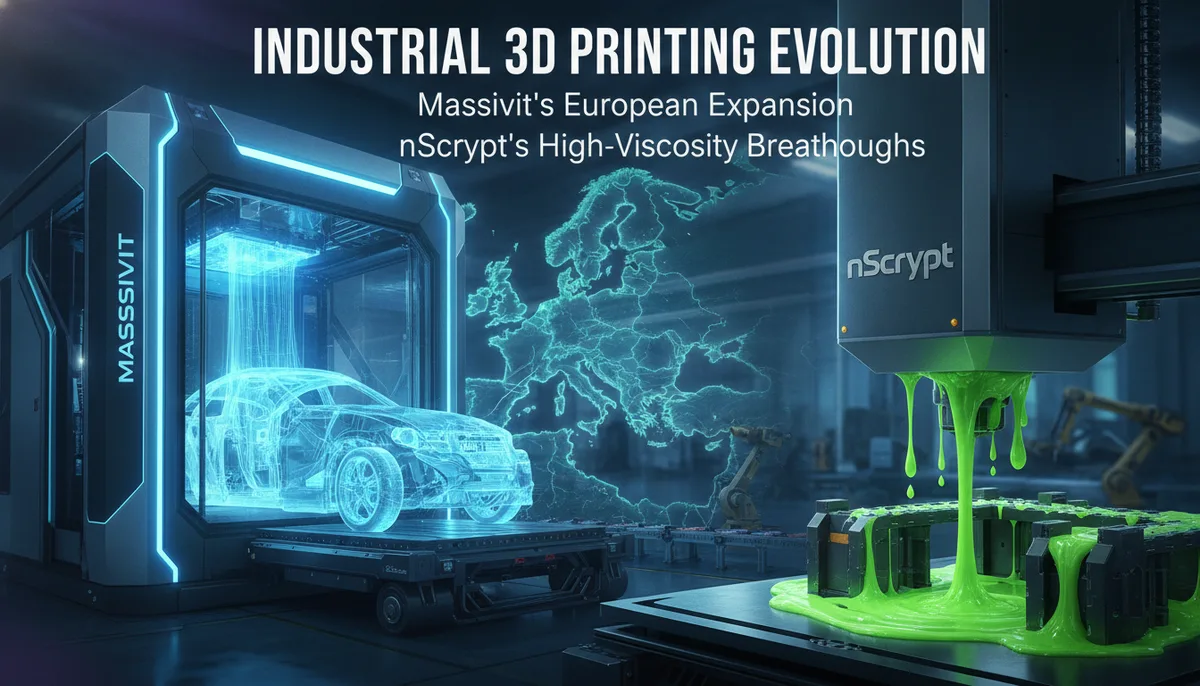
Industrial 3D Printing Evolution: Massivit’s European Expansion and nScrypt’s High-Viscosity Breakthroughs
The landscape of industrial 3D printing is shifting from a focus on "what" can be printed to "how" we support and scale those capabilities globally. In mid-2026, two major developments have signaled a new era of maturity in the additive manufacturing (AM) sector. Massivit has officially inaugurated its first European Service Center to bolster its RapidWings platform, while nScrypt has secured a pivotal patent for high-viscosity material dispensing.
These are not merely corporate milestones; they represent the resolution of two of the biggest hurdles in industrial AM: localized operational reliability and material versatility. As we move further into 2026, the ability to maintain massive robotic systems and print with complex, non-standard materials is what separates experimental labs from true production floors.
Massivit and the RapidWings Platform: Bridging the Support Gap
Massivit has long been a leader in large-format 3D printing, known for its Gel Dispensing Printing (GDP) technology. The introduction of the RapidWings platform pushed the boundaries of how quickly large-scale molds and parts could be produced for the marine and automotive industries. However, as any industrial engineer knows, the machine is only as good as its uptime.
The opening of Massivit’s first European Service Center marks a strategic pivot toward infrastructure. For years, European manufacturers utilizing Israeli or American-based AM technologies faced logistical hurdles regarding specialized maintenance and proprietary part replacement. By establishing a dedicated hub for the RapidWings platform in Europe, Massivit is effectively "de-risking" the investment for European aerospace and maritime firms.
Why Localized Service Matters for Large-Format AM
When dealing with large-scale additive manufacturing (LSAM), the scale of the machinery makes shipping and off-site repairs nearly impossible. These machines are often integrated into robotic cells or massive gantry systems. A localized service center provides:
- Reduced Latency in Technical Support: Real-time troubleshooting with technicians who share the same time zone.
- Spare Parts Logistics: Immediate access to specialized print heads and UV curing components.
- On-Site Training: Facilities where operators can learn the nuances of the RapidWings software and hardware without halting their own production lines.
This move aligns with the broader trend of "Beyond the Gantry," where the focus is on the ecosystem surrounding the printer rather than just the nozzle movement. For more on how these systems are evolving, see our deep dive on Beyond the Gantry: How Addidex Connect is Championing the Robotic 3D Printing Revolution.
nScrypt’s High-Viscosity Patent: Solving the "Ketchup Bottle" Problem
While Massivit scales the size of printing, nScrypt is scaling the complexity of materials. nScrypt was recently granted a patent for a high-viscosity material dispensing system, a move that could revolutionize how we think about "3D printable" substances.
In the world of fluid dynamics, viscosity is the measure of a fluid's resistance to flow. Low-viscosity materials (like water or standard 3D printing resins) are easy to pump and spray. High-viscosity materials—think heavy epoxies, ceramic pastes, or conductive silver inks—behave more like cold peanut butter. They require immense pressure to move, but once they start moving, they are difficult to stop precisely. This is often referred to as the "ketchup bottle effect."
The Technical Breakthrough
nScrypt’s patented technology focuses on a "SmartPump" mechanism that allows for micro-dispensing of these thick materials with pico-liter control. This is vital for:
- Printed Electronics: Laying down conductive traces that are thick enough to carry significant current without spreading or "bleeding" into other components.
- Bio-printing: Handling dense cellular scaffolds that require high-viscosity hydrogels to maintain structural integrity.
- Space and Defense: Utilizing specialized, heavy-duty sealants and adhesives in a 3D-printed workflow.
By mastering high-viscosity materials, nScrypt is moving AM away from the limitations of thermoplastics and toward the functional materials used in traditional high-end manufacturing.
The Intersection of Scale and Material Science
The simultaneous progress of Massivit and nScrypt highlights a converging path in the industry. We are seeing a move toward "Functional Large-Scale Manufacturing." In the past, large-scale prints were often limited to "look-and-feel" prototypes or simple molds. With nScrypt’s ability to handle high-performance, viscous materials and Massivit’s infrastructure to support massive platforms, we are nearing a point where a single robotic cell could print a large structural component and then immediately switch to a high-viscosity head to "print" the internal circuitry or protective coatings.
This level of integration is already being explored in metal additive manufacturing, where specialized alloys are used for industrial-grade parts. For instance, the use of EOS Aluminium Constellium CP1: Revolutionizing Industrial Metal 3D Printing shows how material specificity is becoming the primary driver of AM adoption.
Practical Implications for the 3D Printing Professional
For the professional maker or the industrial consultant, these news briefs suggest three major takeaways for the coming year:
1. Evaluate the "Support Tail"
Before investing in large-format hardware like the RapidWings or similar platforms, evaluate the proximity of service centers. The "support tail"—the cost and time associated with maintaining a machine over five years—is often more expensive than the initial purchase price. Massivit’s expansion suggests that manufacturers are finally listening to this concern.
2. Material Versatility is the New Speed
While "print speed" was the buzzword of 2023 and 2024, "material versatility" is the buzzword of 2026. If your workflow involves post-processing steps like manually applying adhesives or conductive coatings, look toward the advancements made by nScrypt. The goal is to move toward "all-in-one" printing where the high-viscosity components are integrated into the build.
3. Precision in High-Detail Resins
Even outside the industrial sphere, the demand for handling complex materials is trickling down. While nScrypt handles industrial pastes, desktop users are seeing a similar push for resins that balance detail with mechanical durability. If you are working on a smaller scale, choosing the right material remains the most critical decision. See our guide on the 10 Best 3D Printing Resins for Detail and Durability: A Maker’s Guide to see how these material trends are manifesting in the consumer market.
The Role of Patents in Additive Manufacturing Innovation
The nScrypt patent is a reminder that the AM industry is currently in a "land grab" for intellectual property regarding material handling. As the physical patents for FDM (Fused Deposition Modeling) and SLA (Stereolithography) have largely expired, the new frontier is the micro-management of physics.
Patenting the way a pump handles shear-thinning or thixotropic materials (materials that become less viscous under stress) ensures that nScrypt remains a gatekeeper for the next generation of electronics manufacturing. For businesses, this means that "open source" may become harder to find in the high-end industrial sector, making the choice of a hardware partner even more significant.
Looking Forward: A More Robust AM Ecosystem
The news of Massivit’s European expansion and nScrypt’s patent reveals an industry that is maturing. We are moving away from the "Wild West" of 3D printing, where every machine was a DIY project and every material was a gamble.
In 2026, the focus has shifted to reliability, localized support, and the ability to print the "unprintable." Whether you are an engineer at a European shipyard looking at the RapidWings platform or a developer of next-gen medical devices watching nScrypt’s dispensing tech, the message is clear: the infrastructure for the next industrial revolution is finally being built.
By stabilizing the supply chain and expanding the palette of usable materials, the 3D printing industry is proving that it can handle the rigors of 24/7 production environments. As these technologies continue to integrate, the line between "3D printing" and "traditional manufacturing" will continue to blur until they are one and the same.