
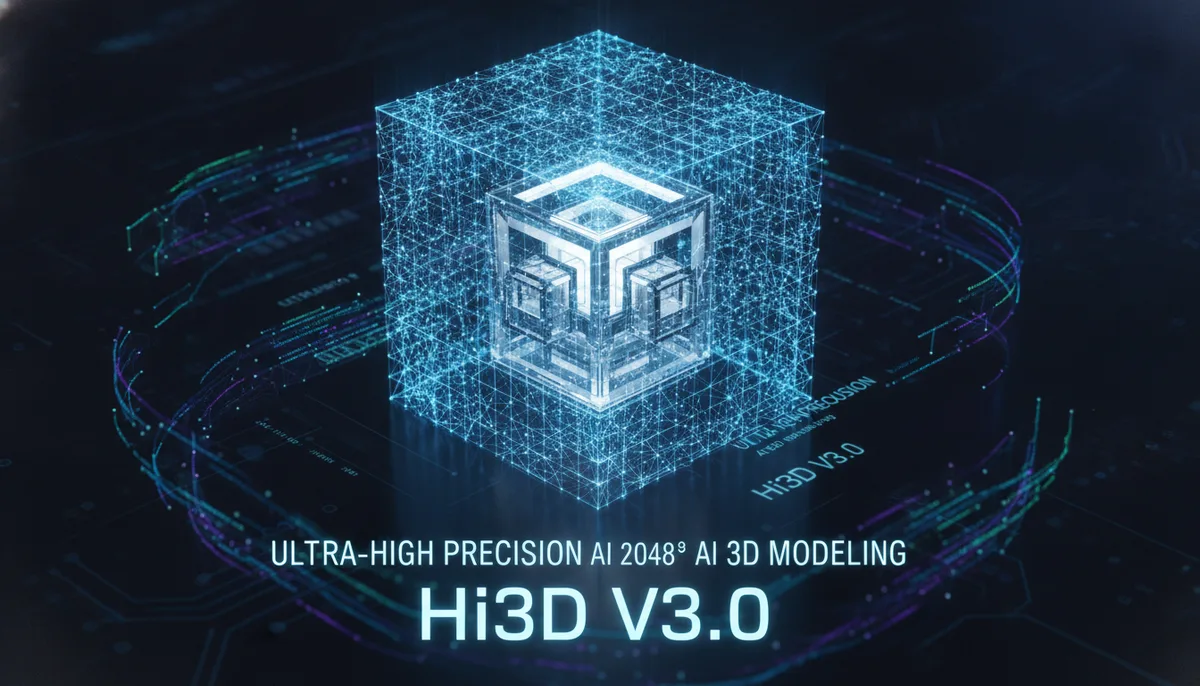
Hi3D V3.0 and the 2048³ Revolution: Why Ultra-High Precision AI 3D Modeling Matters
The landscape of generative artificial intelligence has moved with breakneck speed in the realms of text and 2D imagery. However, the "third dimension"—the creation of complex, manifold, and high-fidelity 3D assets—has traditionally been a much steeper mountain to climb. For years, AI-generated 3D models were often relegated to low-poly "blobs" that required extensive manual retopology and sculpting before they were viable for professional use or high-quality 3D printing.
The launch of Hi3D V3.0 marks a significant pivot point in this evolution. By introducing the industry’s first commercially available AI 3D model with 2048³ voxel resolution, Hi3D is moving beyond the conceptual phase and into the realm of high-precision manufacturing and professional CGI. This leap to 8.5 billion voxels is not just a marginal improvement; it is a fundamental shift in how we bridge the gap between a digital prompt and a physical object.
Understanding the Power of 2048³ Voxel Resolution
To appreciate what Hi3D V3.0 brings to the table, one must understand the "voxel." In 3D space, a voxel (volume pixel) is the three-dimensional equivalent of a pixel in a 2D image. Just as a high-megapixel camera captures more detail, a higher voxel count allows an AI to define the "thickness," texture, and intricate geometry of an object with greater accuracy.
Most existing AI 3D generators operate at resolutions like 256³ or 512³. While these are sufficient for basic shapes or background assets in a video game, they lack the "sharpness" required for detailed 3D printing. At 2048³, the density of data points is exponentially higher. This allows the AI to generate sharp edges, intricate lattice structures, and organic textures that previously required hours of manual labor in software like ZBrush or Blender.
For the maker community, this means the "AI-to-Print" workflow is becoming increasingly seamless. When you are working with 10 Best 3D Printing Resins for Detail and Durability, you need a digital file that matches the physical capabilities of your hardware. A low-resolution AI model will show "stair-stepping" or artifacts even on the best resin printer; Hi3D V3.0 aims to eliminate that bottleneck.
Bridging the Gap: AI Generation for Professional Manufacturing
The implications of Hi3D V3.0 extend far beyond hobbyist figurines. In industrial sectors, the ability to rapidly iterate high-fidelity 3D models can shave weeks off the prototyping phase. We are seeing a convergence where AI-driven design meets advanced material science.
For instance, in the world of metal additive manufacturing, precision is non-negotiable. Technologies like EOS Aluminium Constellium CP1 are revolutionizing industrial 3D printing by offering high-strength, thermally stable components. However, these materials are only as useful as the geometries they form. By utilizing a 2048³ resolution AI model, engineers can generate complex heat sinks or lightweight structural components that are "print-ready" for industrial-grade metal printers.
This level of precision ensures that the AI-generated mesh maintains its structural integrity when scaled. In lower-resolution models, thin walls often collapse or "manifold errors" appear during the slicing process. Hi3D V3.0’s high voxel density significantly reduces these errors, making it a viable tool for professional engineering workflows.
Elegoo Saturn 4 Ultra 12K Resin 3D Printer
The 48-Hour Window: Lowering the Barrier to Entry
One of the most compelling aspects of the Hi3D V3.0 launch is the 48-hour free trial. This is a strategic move to democratize high-precision AI. Historically, high-end 3D generation was gated behind expensive enterprise software or required massive local computing power (GPUs with high VRAM).
By offering a cloud-based, commercially available model with a free entry point, Hi3D is allowing makers to test the limits of what 8.5 billion voxels can do. Whether you are a tabletop gamer looking to create a unique miniature or a product designer prototyping a new ergonomic grip, this trial period provides a low-risk environment to see if AI-generated geometry can meet your specific quality standards.
Practical Workflow: From Prompt to High-Res Mesh
Using Hi3D V3.0 effectively requires a shift in mindset. Because the output is so much more detailed than previous versions, the "garbage in, garbage out" rule of AI is even more pronounced. To get the most out of the 2048³ resolution, users should focus on:
- Descriptive Prompting: Instead of "a dragon," use descriptive language regarding the scales, wing membrane, and skeletal structure. The V3.0 engine has the "headroom" to interpret these details.
- Mesh Optimization: While the voxel resolution is high, the resulting STL or OBJ file can be quite large. Using a tool like MeshLab or Blender to perform a "decimation" that preserves detail while reducing file size for your slicer is still a recommended step for home users.
- Hardware Alignment: If you are generating models at this level of precision, ensure your hardware can keep up. For resin printing, an 8K or 12K screen is ideal to capture the fine details generated by the AI.
Anycubic Photon Mono M5s Pro 14K Resin Printer
The Future of Generative 3D: Beyond the Gantry
As we look at the trajectory of AI in 3D creation, Hi3D V3.0 is a harbinger of a more automated, yet more precise, future. We are moving toward a world where the "gantry" of the traditional 3D printer is no longer the only limit—the limit becomes the speed of our imagination and the resolution of our AI models.
This evolution mirrors the advancements we see in robotics. For example, Beyond the Gantry: How Addidex Connect is Championing the Robotic 3D Printing Revolution highlights how 3D printing is moving into multi-axis robotic arms. When you combine high-resolution AI modeling (like Hi3D V3.0) with multi-axis robotic printing, you unlock the ability to create geometries that were literally impossible to manufacture five years ago.
Why Resolution is the Key to Commercial Viability
The "commercially available" tag on Hi3D V3.0 is perhaps its most important feature. While research labs have toyed with high-res 3D AI for some time, making it accessible to the public at a price point that works for small businesses and independent creators is a game-changer.
In the past, if a small studio needed a high-detail 3D asset, they had to hire a 3D artist (costing hundreds or thousands of dollars) or buy a generic asset from a marketplace. Now, they can generate a bespoke, high-precision base model in minutes, then spend their time on the "artistic finish" rather than the "technical grunt work." This efficiency is what will drive the next wave of 3D printing adoption in the commercial sector.
Final Thoughts: A New Standard for Digital Craftsmanship
Hi3D V3.0 represents a significant milestone in the maturation of AI. By tackling the voxel resolution problem head-on, they have provided a tool that respects the needs of the modern maker and the industrial engineer alike.
The leap to 2048³ is more than just a number; it’s the difference between a toy and a tool. As more users take advantage of the 48-hour free trial, we expect to see a surge in complex, AI-assisted designs hitting the build plates of printers worldwide. Whether you are printing in resin, plastic, or metal, the era of high-precision AI 3D modeling has officially arrived.
Creality Halot-Mage S 14K Resin 3D Printer