
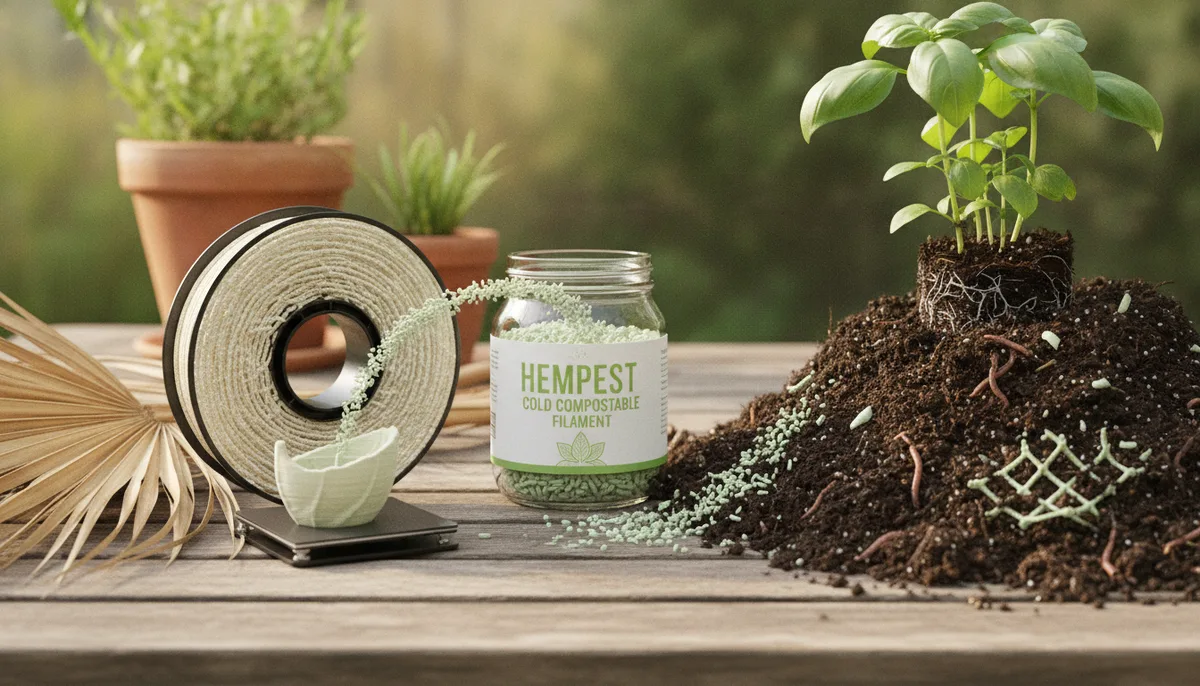
From Palm Leaves to Garden Compost: The Rise of Hembased Cold Compostable Filament
The Sustainability Gap in 3D Printing
For years, the 3D printing community has leaned on PLA (Polylactic Acid) as the "green" alternative to petroleum-based plastics like ABS. Derived from corn starch or sugarcane, PLA is technically biodegradable—but there is a catch that many hobbyists are unaware of. Most PLA requires industrial composting facilities, utilizing high temperatures and specific microbial environments to break down. If a PLA fail-print ends up in a backyard compost pile or a landfill, it can persist for decades, much like traditional plastic.
The Dutch firm Hembased is aiming to bridge this gap with the launch of their new cold compostable filament. By utilizing palm leaves as a primary feedstock, Hembased is offering a material that doesn't just claim to be eco-friendly in theory; it is designed to return to the earth in a standard garden compost bin. This move represents a significant shift toward a truly circular economy within the additive manufacturing space.
Understanding Cold Compostable Technology
The term "cold compostable" is the gold standard for environmental responsibility in plastics. While many materials are marketed as "bio-based," that label only refers to the source of the material, not its end-of-life behavior.
Why Palm Leaves?
Palm leaves are an abundant agricultural byproduct. In many parts of the world, fallen palm leaves are treated as waste or burned, contributing to carbon emissions. By upcycling these fibers into 3D printing filament, Hembased is practicing "valuable waste" management. The natural cellulose and lignin found in palm leaves provide the structural integrity needed for 3D printing while remaining recognizable to the fungi and bacteria present in a typical home compost heap.
The Breakdown Process
When you place a print made from Hembased filament into a compost bin, the moisture and naturally occurring microorganisms begin to colonize the surface. Unlike traditional plastics that break down into harmful microplastics, cold compostable filaments are designed to be consumed by these organisms, eventually turning into water, CO2, and nutrient-rich biomass. This makes it an ideal choice for temporary prints, prototypes, or garden-related items that may eventually need disposal.
Technical Printing Considerations
Transitioning to a bio-composite filament like the one offered by Hembased requires a slight shift in printing mindset. While it is designed for ease of use, natural fiber filaments have unique characteristics compared to pure polymers.
Temperature and Flow
Natural fibers can be sensitive to extreme heat. Printing with palm-leaf-based materials usually requires finding a "sweet spot" where the binder melts sufficiently for layer adhesion without scorching the organic fibers. Users should expect a matte, organic finish that hides layer lines better than glossy PLA.
Hardware Longevity
Because bio-composites contain actual fibers, they can be slightly more abrasive than standard PLA. If you plan on printing large volumes of sustainable materials, upgrading to a hardened steel nozzle is a wise investment to prevent the bore from widening over time. Additionally, ensuring your printer is properly housed can help maintain consistent ambient temperatures. For more on the benefits of controlled printing environments, see our guide: Is an Enclosure Necessary for Your 3D Printer? A Guide to Safety and Quality.
Practical Applications for Cold Compostable Filament
Not every 3D print is intended to last forever. In fact, a significant portion of the "maker" output consists of temporary jigs, fit-test prototypes, and decorative items. This is where Hembased's material shines.
- Horticultural Tools: Print seed starter pots, plant markers, or trellis clips. When the season is over, or the plant outgrows the pot, the entire assembly can be moved to the compost or buried directly in the soil.
- Prototyping: Designers can iterate through dozens of versions of a product without the "plastic guilt" of filling a trash can with discarded revisions.
- Event Decor: Temporary signage, table centerpieces, and party favors can be disposed of responsibly once the event concludes.
- Educational Projects: Schools can use these materials to teach both additive manufacturing and environmental science, showing students the full lifecycle of a product.
The Broader Impact: Additive Manufacturing as a Force for Good
The innovation from Hembased isn't just about hobbyist convenience; it’s about the global footprint of manufacturing. As we look at the role of 3D printing in global logistics, the ability to produce items locally from sustainable sources is a game-changer.
In humanitarian contexts, where waste management infrastructure may be non-existent, the use of compostable materials ensures that the benefits of 3D printing don't come at the cost of local environmental degradation. We have previously explored how 3D Printing as a Humanitarian Force is changing lives in regions like Venezuela; integrating compostable materials into these efforts could further enhance their sustainability.
Comparing Hembased to Other Eco-Filaments
How does this new palm-leaf filament stack up against other "green" options on the market?
| Feature | Hembased Palm Leaf | Standard PLA | Recycled PETG |
|---|---|---|---|
| Base Material | Palm Leaves / Bio-binder | Corn Starch / Sugarcane | Recycled Plastic Waste |
| Compostability | Cold (Backyard) | Industrial Only | Non-compostable |
| Finish | Matte / Earthy | Glossy / Semi-matte | Transparent / Glossy |
| Heat Resistance | Moderate | Low | Moderate/High |
| Best Use Case | Temporary/Garden | General Purpose | Mechanical Parts |
While recycled filaments (like recycled PETG) are excellent for keeping existing plastic out of landfills, they still result in a product that will last for centuries. Hembased offers a different path: a material that exists only as long as it is needed.
Conclusion: A New Standard for the "Green" Maker
The launch of Hembased’s cold compostable filament marks an important milestone for the 3D printing industry. It challenges the "disposable plastic" culture by providing a high-performance material that respects the natural lifecycle. For makers who are conscious of their environmental footprint, the ability to turn a failed print into fertilizer for their garden is the ultimate "undo" button.
As we continue to see advancements in material science—from industrial metals like EOS Aluminium Constellium CP1 to organic palm-leaf composites—the 3D printing landscape is becoming more diverse, more capable, and more responsible.
Whether you are a hobbyist looking to reduce your waste or a professional designer seeking sustainable prototyping solutions, Hembased's palm-leaf filament is a significant step toward a cleaner, greener future for additive manufacturing.