
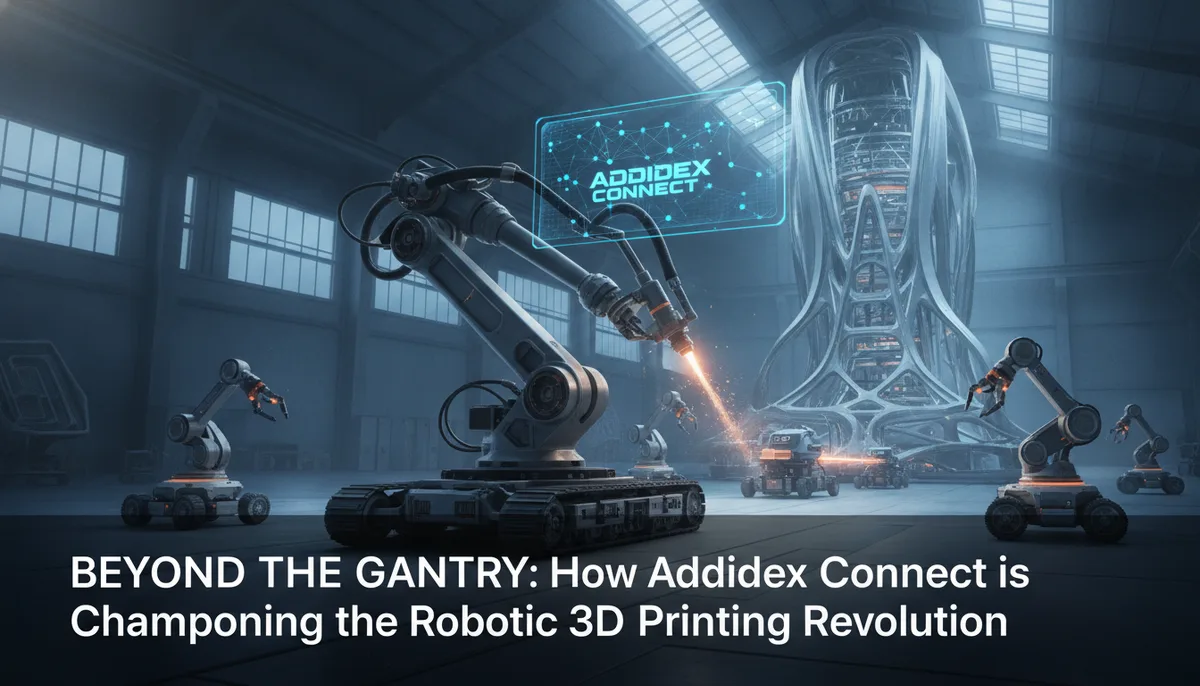
Beyond the Gantry: How Addidex Connect is Championing the Robotic 3D Printing Revolution
The landscape of additive manufacturing is undergoing a seismic shift. For years, the industry was defined by the "box"—the rigid XYZ gantry systems that limited build volumes to the physical dimensions of the machine's frame. However, a new movement is breaking these boundaries, replacing fixed rails with the fluid, multi-axis dexterity of industrial robotic arms.
Recently, the historic city of Haarlem became the epicenter of this transformation. Addidex, an Amsterdam-based leader in robotic large-format additive manufacturing (LFAM), hosted Addidex Connect. This two-day symposium was a dedicated deep dive into the world of "robots printing things," drawing 170 of the brightest minds in the additive sector to discuss, demonstrate, and define the future of large-scale production.
The Significance of Addidex Connect in the AM Ecosystem
While massive trade shows often cover everything from dental resins to metal sintering, Addidex Connect chose a surgical focus: the intersection of robotics and large-format extrusion. The attendance of 170 specialists signifies a maturing niche. These aren't just hobbyists; these are engineers, software developers, and industrial designers looking to scale 3D printing into the realms of infrastructure, maritime, and aerospace.
The event highlighted that robotic AM is no longer a "science project." It has moved into a phase of industrial reliability. By focusing the conversation exclusively on robotic integration, Addidex has created a community around the unique challenges of LFAM—challenges that differ significantly from those faced by desktop or even standard industrial gantry users.
Breaking the Gantry: Why Robotic Arms are the Future of Scale
The primary limitation of traditional 3D printing is the build volume. If you want to print a boat hull or a wind turbine blade, a gantry-based system requires a massive, expensive, and often permanent structure. Robotic arms, however, offer a different value proposition.
6-Axis Freedom and Non-Planar Printing
Traditional printers work in layers—flat slices stacked on top of each other. Robotic arms, typically featuring six axes of motion, allow for non-planar printing. This means the print head can move at angles, following the contours of a part. This capability significantly reduces the need for support structures, which saves both time and material.
Mobility and Reach
A robotic arm can be mounted on a rail (adding a 7th axis) or even a mobile platform. This allows the "build volume" to become virtually infinite. In the context of the discussions at Addidex Connect, this mobility is key for the decentralized manufacturing of large-scale components directly on-site, whether that be a construction site or a shipyard.
The Material Shift: From Filament Spools to Pellet Extrusion
One of the recurring themes at the Haarlem symposium was the transition in material feedstocks. While desktop users are familiar with the debate of PLA vs PETG: Which Filament Should You Start With?, the robotic LFAM world operates on a different scale.
To make large-format printing economically viable, the industry is moving toward pellet extrusion. Pellets (the same raw plastic granules used in traditional injection molding) are significantly cheaper than processed filament. Furthermore, pellet extruders can achieve much higher flow rates—essential when you are printing objects the size of a car.
During the sessions at Addidex Connect, experts highlighted the importance of material science in preventing warping in these large-scale prints. When you are depositing kilograms of plastic per hour, thermal management becomes the primary engineering hurdle.
Software: The Invisible Engine of Robotic AM
Hardware is only half the battle. One of the most significant takeaways from Addidex Connect was the focus on the "digital thread." Programming a 6-axis robot to extrude plastic is infinitely more complex than slicing a file for a standard 3D printer.
Attendees discussed the evolution of dedicated LFAM software that accounts for:
- Robot Kinematics: Ensuring the arm doesn't collide with the part or itself.
- Thermal Simulation: Predicting how a massive part will cool and shrink to avoid structural failure.
- Toolpath Optimization: Creating efficient paths that leverage the multi-axis capability of the arm rather than just mimicking flat layers.
This software evolution is a global trend. Just as we see Australia’s $3.25 Million Boost for 3D Printing aimed at helping SMEs innovate, the software tools showcased in Haarlem are designed to lower the barrier to entry for smaller firms looking to adopt robotic automation.
Real-World Applications: What Are These Robots Printing?
The symposium wasn't just theoretical. The 170 attendees saw and discussed real-world applications that are currently reshaping industries:
- Tooling and Molds: Instead of machining massive blocks of foam or metal, companies are 3D printing molds for carbon fiber layup in the aerospace and automotive sectors.
- Architectural Features: From custom facades to structural stay-in-place formwork for concrete, robots are bringing complex geometry to the construction world.
- Maritime Components: Printing large-scale boat hulls or interior components that are lighter and more sustainable than traditional fiberglass methods.
The versatility of these systems is also reflected in broader industry movements, such as those discussed in the 3D Printing News Briefs July 2026, where material innovations and leadership shifts are steering the industry toward more robust industrial applications.
Challenges to Overcome: The Road Ahead for LFAM
Despite the enthusiasm in Haarlem, the path to mainstream adoption of robotic 3D printing isn't without obstacles. The symposium addressed several "pain points" that the industry must solve:
- Surface Finish: Large-scale prints often have visible layer lines (sometimes called "corduroy"). While functional for many applications, some industries require secondary machining to achieve the desired finish.
- Standardization: Unlike traditional manufacturing, there are currently few global standards for the structural integrity of 3D-printed large-scale parts.
- Skill Gap: Operating a robotic AM cell requires a blend of skills—robotics programming, materials science, and additive design—that are currently in short supply.
Conclusion: A New Era of Manufacturing
Addidex Connect proved that the robotic 3D printing community is no longer a fringe group. By bringing together 170 experts in Haarlem, Addidex has solidified the notion that the future of large-scale manufacturing is automated, multi-axis, and additive.
The move away from the constraints of the gantry toward the freedom of the robotic arm represents more than just a change in machinery; it represents a change in how we conceive of building the world around us. As software becomes more intuitive and materials become more specialized, the "robotic print shop" will likely become a staple of modern industrial hubs.
For those looking to enter this space, the message from Haarlem is clear: the technology is ready, the community is growing, and the only limit now is the reach of the robotic arm.