
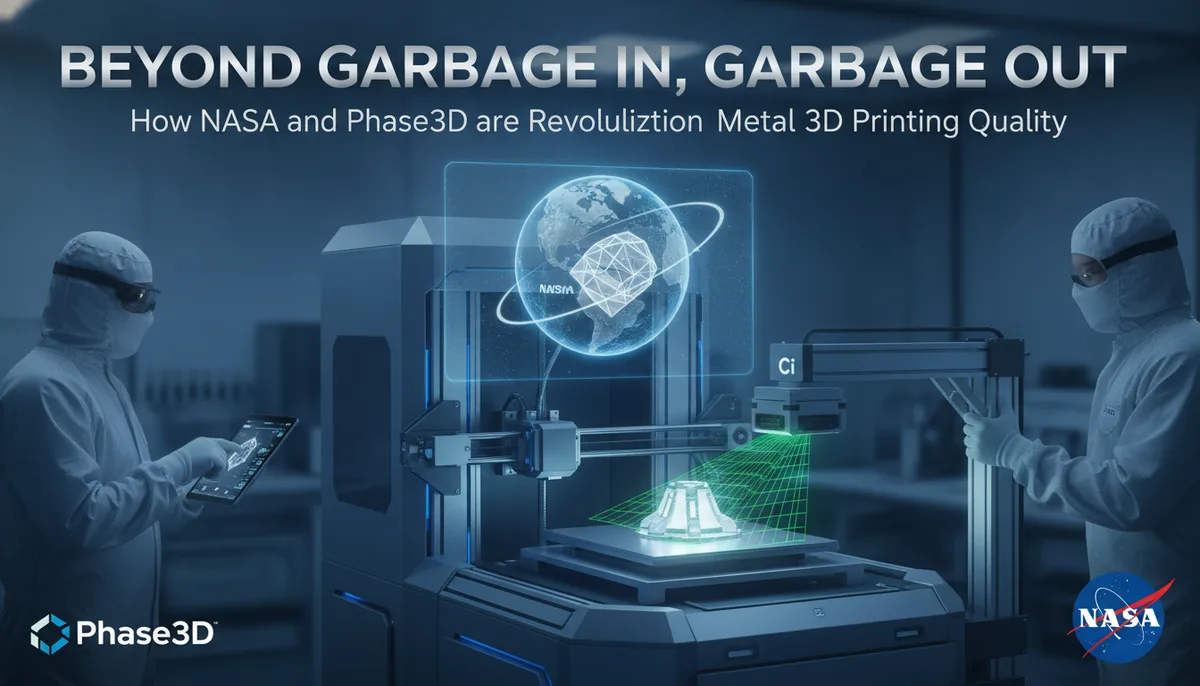
Beyond Garbage In, Garbage Out: How NASA and Phase3D are Revolutionizing Metal 3D Printing Quality
The old adage "Garbage in, garbage out" (GIGO) has long been the ghost in the machine for computer science and data analytics. It suggests that the quality of an output is strictly dependent on the quality of the input. In the high-stakes world of aerospace manufacturing, this principle is more than a cliché; it is a multi-million dollar hurdle. When NASA prints a critical engine component using metal additive manufacturing (AM), a single microscopic flaw in the first layer can lead to a catastrophic failure in the final product.
To combat this, NASA has recently awarded a Phase II Small Business Innovation Research (SBIR) contract to Phase3D, a company specializing in real-time monitoring for additive manufacturing. This partnership aims to move metal 3D printing away from the "print and pray" era and toward a future of "certified-as-printed" reliability.
The High Stakes of Metal Additive Manufacturing
Metal 3D printing, specifically Laser Powder Bed Fusion (LPBF), is transforming how we build spacecraft. It allows for the creation of complex geometries that are impossible to manufacture through traditional milling or casting. However, the process is notoriously difficult to control.
In LPBF, a thin layer of metal powder is spread across a build plate, and a laser melts specific areas to form a layer of the part. This process repeats thousands of times. If the powder is spread unevenly—a common issue known as a "recoater streak"—or if the laser power fluctuates, the resulting part may have internal voids or structural weaknesses.
Currently, the only way to ensure these parts are safe for flight is through extensive post-process inspection, including X-ray computed tomography (CT) scanning. This is not only incredibly expensive but also time-consuming. If a defect is found after a 100-hour print, the entire part is scrapped, wasting thousands of dollars in high-end materials like EOS Aluminium Constellium CP1: Revolutionizing Industrial Metal 3D Printing.
Solving the GIGO Problem with In-Situ Monitoring
The NASA-funded research with Phase3D focuses on "in-situ" monitoring—checking the quality of the print while it is happening. By identifying "garbage" inputs (like a bad powder layer) the moment they occur, manufacturers can either pause the build to correct the issue or scrap the part early, saving time and resources.
Phase3D’s approach utilizes a technology called Fringe Projection. Unlike standard 2D cameras that simply take a photo of the build area, fringe projection uses structured light to create a detailed 3D height map of every single layer.
How Fringe Projection Works
- Light Patterning: A projector casts a series of light patterns (fringes) across the powder bed.
- Deformation Analysis: As these patterns hit the surface, they deform based on the height and topography of the powder and the melted metal.
- Height Mapping: High-speed sensors capture these deformations and translate them into a topographical map with micron-level precision.
This allows the system to detect "protrusions" (where the metal has warped upward) or "short feeds" (where there isn't enough powder), providing a level of data that 2D visual systems simply cannot match.
The NASA Partnership: Advancing Objective Inspection
The SBIR Phase II contract isn't just about spotting mistakes; it’s about creating a standardized, objective way to measure "good" vs. "bad" in 3D printing. NASA’s interest lies in the "Projected Fringe Imaging Control System" (PFICS). This system is designed to be hardware-agnostic, meaning it can be integrated into various industrial metal printers.
By collecting objective data across different machines and materials, NASA and Phase3D are building a roadmap for "in-situ certification." Imagine a world where a 3D printer generates a digital twin of the part as it prints. By the time the build is finished, the manufacturer has a complete data set proving the internal integrity of the part, potentially bypassing the need for some forms of destructive testing.
This level of automation and data-driven manufacturing is a significant leap forward, mirroring the advancements we are seeing in other sectors of the industry, such as the move Beyond the Gantry: How Addidex Connect is Championing the Robotic 3D Printing Revolution.
Beyond Aerospace: The Trickle-Down Effect
While NASA’s primary focus is on space-faring hardware, the implications of Phase3D’s research will eventually reach the broader manufacturing sector. As in-situ monitoring becomes more affordable and accessible, we can expect to see it implemented in medical implants, automotive components, and even high-end consumer goods.
For the professional maker or small-scale industrial shop, the lesson is clear: data is the most valuable material in the build chamber. While most hobbyist printers don't yet have fringe projection, the trend toward monitoring is already visible in the consumer market with AI-powered cameras and lidar sensors.
The Importance of Quality Control in Modern AM
The "Garbage In, Garbage Out" principle reminds us that a 3D printer is only as good as the process it follows. For those operating at the industrial level, the NASA/Phase3D collaboration highlights three critical pillars of modern AM:
- Repeatability: Ensuring that the 100th part is identical to the 1st.
- Traceability: Having a digital "birth certificate" for every part that documents every layer of its creation.
- Efficiency: Reducing the "scrap rate" by identifying failures in real-time.
As we continue to push the boundaries of what additive manufacturing can achieve, the focus is shifting from the mechanics of the print to the intelligence of the system. We are no longer just building objects; we are building data-well-regarded structures.
Practical Guidance for Navigating the Future of AM
If you are involved in industrial 3D printing or are looking to scale your manufacturing capabilities, there are several steps you can take to align with these emerging standards:
- Invest in Monitoring: If your budget allows, prioritize machines with integrated sensor suites. Even basic visual monitoring can prevent simple failures from becoming expensive disasters.
- Standardize Your Powder Handling: In metal AM, the quality of the powder is the ultimate "input." Ensure your storage and sieving processes are airtight to prevent contamination.
- Maintain Your Environment: Just as an enclosure is vital for desktop print quality, climate control is essential for industrial metal AM. For more on the importance of controlled environments, see our guide: Is an Enclosure Necessary for Your 3D Printer? A Guide to Safety and Quality.
Conclusion: A New Standard for Additive Manufacturing
The collaboration between NASA and Phase3D represents a turning point for the industry. By addressing the GIGO problem at the source—the layer-by-layer deposition of material—they are paving the way for a future where 3D printing is as reliable and predictable as traditional forging.
As in-situ monitoring technology matures, it will move from a specialized tool for rocket scientists to a standard feature of the industrial floor. The goal is no longer just to print a part, but to print a part with the absolute certainty that it will perform when it matters most. In the vacuum of space or the high-pressure environment of a jet engine, there is no room for "garbage" inputs. Thanks to Phase3D and NASA, we are closer than ever to total manufacturing transparency.