
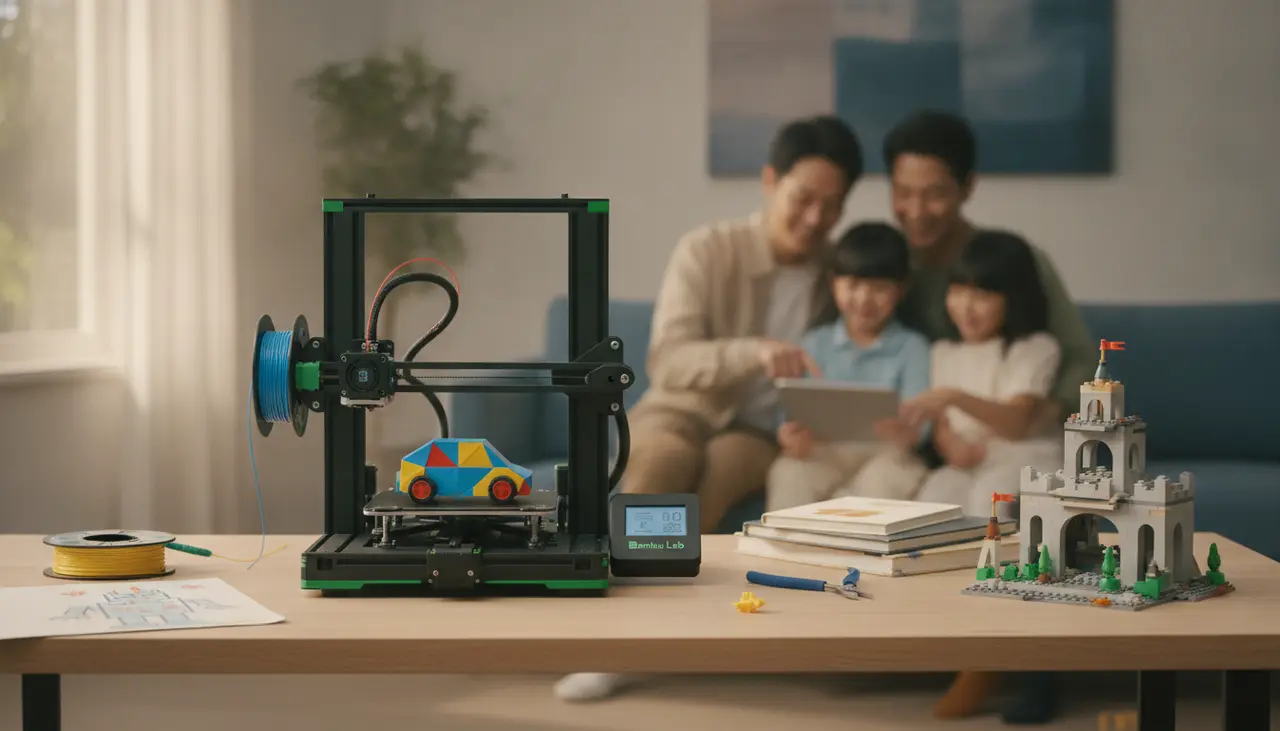
Bambu Lab P1P Review: Is This High-Speed Printer the Best Choice for Families?
Affiliate Disclosure: This post contains affiliate links to the Bambu Lab store. If you make a purchase through these links, The 3D Print Nook may earn a small commission at no extra cost to you. This helps us keep our guides free and accessible for the maker community.
If you have been eyeing the 3D printing world for a while, you have likely heard the buzz surrounding Bambu Lab. For years, the hobby was defined by "tinkering"—spending hours leveling beds and tightening belts before you could even think about printing a simple tugboat. The Bambu Lab P1P changed that narrative almost overnight.
The Quick Verdict: Is the P1P the "Speed King" for Families?
Yes, the Bambu Lab P1P is currently one of the most approachable, high-speed 3D printers for families and hobbyists. It effectively removes the "technical tax" that usually comes with 3D printing. Instead of spending your Saturday morning troubleshooting hardware, the P1P allows you to go from unboxing to a finished print in under an hour.
While it lacks the full enclosure of its more expensive siblings, its CoreXY motion system and sophisticated software make it a reliable workhorse for anyone who wants to focus on creating rather than fixing their machine.
Who is the Bambu Lab P1P For?
This printer is designed for the "results-oriented" maker. If you are a parent looking to print toys with your kids, a cosplayer needing rapid prototypes, or a DIYer who wants functional home organization tools without a steep learning curve, this is your machine.
It bridges the gap between the ultra-budget kits that require constant maintenance and the high-end industrial machines that cost thousands. It’s for the person who wants the "Apple experience" of 3D printing—it just works.
Key Specifications at a Glance
| Feature | Bambu Lab P1P Specification |
|---|---|
| Motion System | CoreXY (High Speed & Stability) |
| Build Volume | 256 x 256 x 256 mm |
| Max Speed | 500 mm/s |
| Bed Leveling | Fully Automatic (Abl) |
| Filament Compatibility | PLA, PETG, TPU, PVA (Enclosure recommended for others) |
| Connectivity | Wi-Fi, Bluetooth, Bambu Bus |
The Features That Make Life Easier
1. True Plug-and-Play Setup
Most traditional 3D printers arrive as a box of parts. The P1P arrives almost entirely assembled. You’ll spend more time removing the protective foam than you will actually building the printer. For a family-friendly environment, this is a massive win—you can get the kids involved in the first print within 20 minutes of the delivery driver leaving.
2. Speed Without the Sacrifice
The P1P uses a CoreXY architecture. In simple terms, this means the heavy "bed" only moves up and down, while the lightweight "print head" zips around horizontally. This allows the P1P to print up to 5 times faster than a standard budget printer without losing detail. Projects that used to take 10 hours now take 3, making it much easier to manage "I want it now" requests from the family.
3. The Bambu Studio Ecosystem
The software (or "Slicer") is often the hardest part for beginners to learn. Bambu Studio is remarkably intuitive. It handles the complex math of 3D printing behind the scenes, offering "one-click" printing options that are surprisingly reliable.
Practical Trade-offs: What to Consider
While we love the P1P, no printer is perfect. Because it has an "open-frame" design (no sides or top), it can be quite loud when printing at high speeds. The fans are powerful, and you will definitely hear it from the next room.
Additionally, the open frame means it struggles with materials like ABS or ASA, which need a warm, draft-free environment. For most beginners, this isn't an issue, as you will likely start with PLA or PETG. If you're wondering which to choose for your first roll, check out our guide on PLA vs PETG: Which Filament Should You Start With? to see which fits your projects better.
Best Use-Cases for the P1P
- The Busy Parent: Perfect for printing school project components, custom cookie cutters, or replacement toy parts on a tight schedule.
- The "Non-Techy" Creative: If you love 3D modeling but hate mechanical repairs, the P1P’s auto-leveling and vibration compensation will be your best friends.
- The Productivity Maker: If you are starting a small Etsy shop, the speed of the P1P allows you to cycle through orders much faster than a standard "bed slinger" printer.
Common Beginner Mistakes to Avoid
Even with a machine as smart as the P1P, there are a few pitfalls to watch out for:
- Neglecting the Build Plate: Even though the P1P has great adhesion, skin oils from your fingers can cause prints to peel. Wash your PEI plate with simple dish soap and warm water every few prints.
- Skipping the Calibration: The P1P performs a "vibration calibration" and "bed leveling" before prints. It’s tempting to skip these to save five minutes, but letting the machine "stretch its muscles" ensures a perfect first layer every time.
- Ignoring Filament Moisture: Just because the printer is high-tech doesn't mean the plastic is. Keep your filament dry to avoid stringing and "zits" on your beautiful prints.
If you find yourself wanting to push the machine even further, you might eventually look into 5 essential upgrades for your first 3D printer to see how small tweaks can lead to even smoother results.
Frequently Asked Questions (FAQ)
Does the P1P come with a camera? Yes, the P1P includes a low-frame-rate chamber camera that allows you to monitor your prints from your phone using the Bambu Handy app. It’s great for peace of mind!
Can I upgrade it later? Absolutely. One of the coolest things about the P1P is that Bambu Lab encourages you to "printable-upgrade" it. You can print your own side panels to give it a custom look or buy the official kit to add an enclosure later.
Is it safe for a child's bedroom? We generally recommend keeping any 3D printer in a well-ventilated area like a home office or a dedicated craft room. While PLA is relatively low-odor, the P1P's fans move a lot of air, and it's best to have some circulation.
Final Thoughts
The Bambu Lab P1P represents a shift in the hobby. It moves 3D printing away from being a "mechanical hobby" and toward being a "creative tool." If you have the budget to step up from the $200 entry-level kits, the P1P rewards you with time saved and frustration avoided. It truly is a "speed king" that the whole family can enjoy.
Ready to start your journey? View the Bambu Lab P1P at the Official Bambu Store