
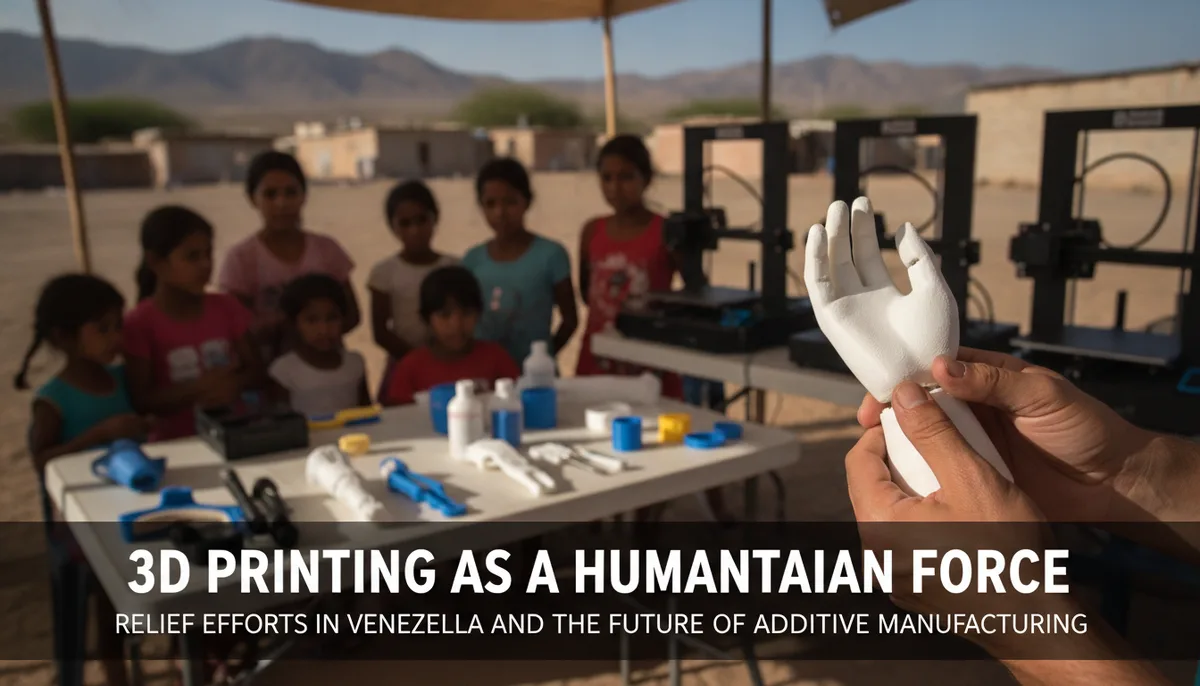
3D Printing as a Humanitarian Force: Relief Efforts in Venezuela and the Future of Additive Manufacturing
The landscape of additive manufacturing (AM) has shifted dramatically over the last few years. What was once a tool primarily for rapid prototyping and hobbyist experimentation has matured into a cornerstone of global crisis response and industrial stability. As of July 2026, we are seeing the true potential of "distributed manufacturing" put to the test.
In this week’s 3D printing news, two distinct but equally important developments highlight the trajectory of the industry: the deployment of 3D printing for earthquake relief in Venezuela and the release of new technical white papers that aim to standardize the next generation of AM workflows. These updates underscore a move toward a more resilient, documented, and socially impactful manufacturing ecosystem.
3D Printing for Humanitarian Relief: The Venezuela Response
When natural disasters strike, the primary challenge is often logistical. Infrastructure—roads, bridges, and ports—is frequently compromised, making the delivery of traditional aid slow and expensive. Following the recent earthquakes in Venezuela, the 3D printing community and non-governmental organizations (NGOs) have stepped up to fill the gap.
Rapid Deployment of Medical and Functional Parts
In the immediate aftermath of a disaster, medical supplies are the first to run out. 3D printing allows for the production of "point-of-care" devices. Instead of waiting for a shipment of orthopedic splints or surgical guides to navigate a damaged supply chain, relief workers can utilize portable 3D printing hubs to manufacture these items on-site.
The relief efforts in Venezuela have focused on:
- Custom Orthopedic Splints: Tailored to individual patients to ensure better healing of fractures caused by falling debris.
- Water Filtration Components: Printing housings and connectors for portable filtration systems to prevent the spread of waterborne diseases.
- Replacement Infrastructure Parts: Small but critical components for generators and communication equipment that keep rescue operations running.
This localized approach is a practical application of the concepts discussed in Australia’s $3.25 Million Boost for 3D Printing: A New Era for SMEs and Additive Innovation, where the focus on small-to-medium enterprise innovation translates directly into agile, mobile response teams.
The Challenge of Power and Material Stability
Operating 3D printers in a disaster zone is not without its hurdles. Unreliable power grids require the use of solar-powered "print farms" or high-capacity battery backups. Furthermore, the choice of material is critical. In the humid and unpredictable climate of Venezuela, makers must choose filaments that can withstand environmental degradation.
For those looking to understand the fundamental differences in material durability for functional parts, our guide on PLA vs PETG: Which Filament Should You Start With? provides essential context on why PETG is often the superior choice for outdoor or mechanical relief applications.
The Role of Industry White Papers in 2026
While humanitarian efforts show the "heart" of 3D printing, technical white papers represent the "brain." The news of a new white paper circulating in the industry marks a pivotal moment for standardization. In 2026, the focus of these documents has shifted from "can we print this?" to "how do we certify that this print is safe and repeatable?"
Bridging the Gap Between Hobbyist and Industrial Standards
For years, the 3D printing industry lacked a unified set of standards for material properties and machine calibration. The latest white papers are addressing this by providing data-backed frameworks for:
- Material Fatigue Life: Understanding how 3D-printed parts hold up over thousands of cycles of stress.
- Environmental Impact: Documenting the lifecycle of resins and filaments to meet new global sustainability mandates.
- AI-Driven Quality Control: Integrating machine learning to detect print failures in real-time.
These documents are vital for SMEs who want to move into high-stakes industries like aerospace or medical device manufacturing. Without the technical validation found in these papers, 3D printing remains a "best effort" technology rather than a "guaranteed" one.
The Evolution of the 3D Printing Workflow
As we look at the news from July 2026, it is clear that the "gantry-style" printer is no longer the only player in the game. The industry is moving toward more complex, multi-axis systems that can handle larger and more intricate tasks.
Beyond the Gantry: Robotic Integration
The mention of new white papers often coincides with advancements in robotic 3D printing. Traditional printers are limited by their build volume and the need for support structures. However, robotic arms equipped with extruders are breaking these boundaries.
This evolution is explored deeply in our feature on Beyond the Gantry: How Addidex Connect is Championing the Robotic 3D Printing Revolution. By removing the constraints of the X, Y, and Z axes, we can print larger structures—perhaps even temporary housing or large-scale infrastructure—directly in disaster-stricken areas like those in Venezuela.
The Necessity of Enclosures in Professional Settings
Whether in a lab or a field hospital, the environment in which a part is printed significantly affects its structural integrity. As white papers emphasize the need for "controlled environments," the use of enclosures has moved from an optional accessory to a mandatory requirement for professional-grade results.
Maintaining a consistent ambient temperature prevents warping and ensures that layers bond correctly, which is life-or-death when printing medical tools. If you are setting up a professional or high-reliability printing station, consider the technical requirements discussed in our guide on Is an Enclosure Necessary for Your 3D Printer? A Guide to Safety and Quality.
Practical Guidance: How You Can Contribute to Distributed Manufacturing
The news of relief efforts in Venezuela often inspires makers to ask how they can help. While sending a printer to a disaster zone is difficult, there are ways to participate in the global network of distributed manufacturing.
Joining Open-Source Medical Networks
Organizations like Field Ready and Tikkun Olam Makers (TOM) maintain libraries of "evaluated" 3D models. These are designs that have been tested and approved for use in humanitarian settings.
- Step 1: Calibration. Ensure your printer is calibrated to produce dimensionally accurate parts. A 1mm error in a pipe connector can render it useless.
- Step 2: Material Selection. Use high-quality, industrial-grade filaments. Avoid "budget" brands that may have inconsistent diameters or hidden impurities.
- Step 3: Documentation. Follow the guidelines set out in industry white papers regarding print orientation and infill density to ensure maximum strength.
Looking Ahead: The Future of Additive Manufacturing
The news from July 11, 2026, serves as a reminder that 3D printing is a tool of empowerment. In Venezuela, it is a tool of survival. In the corporate boardroom, through white papers, it is a tool of economic transformation.
As we move forward, the integration of 3D printing with other technologies—like AI-assisted design and robotic assembly—will only continue to accelerate. The "News Briefs" we read today are the blueprints for the global supply chains of tomorrow. By staying informed on both the humanitarian applications and the technical standards, the 3D printing community can ensure that this technology continues to serve the world in meaningful, reliable ways.
Whether you are a hobbyist looking to start with your first roll of filament or a professional engineer navigating the latest white papers, the goal remains the same: to create something that wasn't there before, exactly where it is needed most.